Several years back, a will was something that required a person to meet with an attorney, discuss all his belongings and have a draft prepared. The document was then printed and the person needed two witnesses who saw him sign the document. Today, however, the entire process may be done from a laptop or mobile and people have access to platforms that aid them in organizing their valuables, appointing beneficiaries and drafting their wills online.
This has naturally created a new question for Indian families: Digital will vs traditional will, which one is actually better?
The question cannot be answered with a simple solution of modern vs. traditional. In fact, even a will written using technology can eventually result in a physical will executed under the conventional manner because legislation in India still makes it essential for executing and witnessing of a will. The Information Technology Act of 2000 has not included wills in its ambit of usage, but the other laws regarding succession specify specific requirements about the way wills must be executed and attested.
There is thus a need to examine both the similarities and the differences between the traditional method of will writing with that of the new online service.
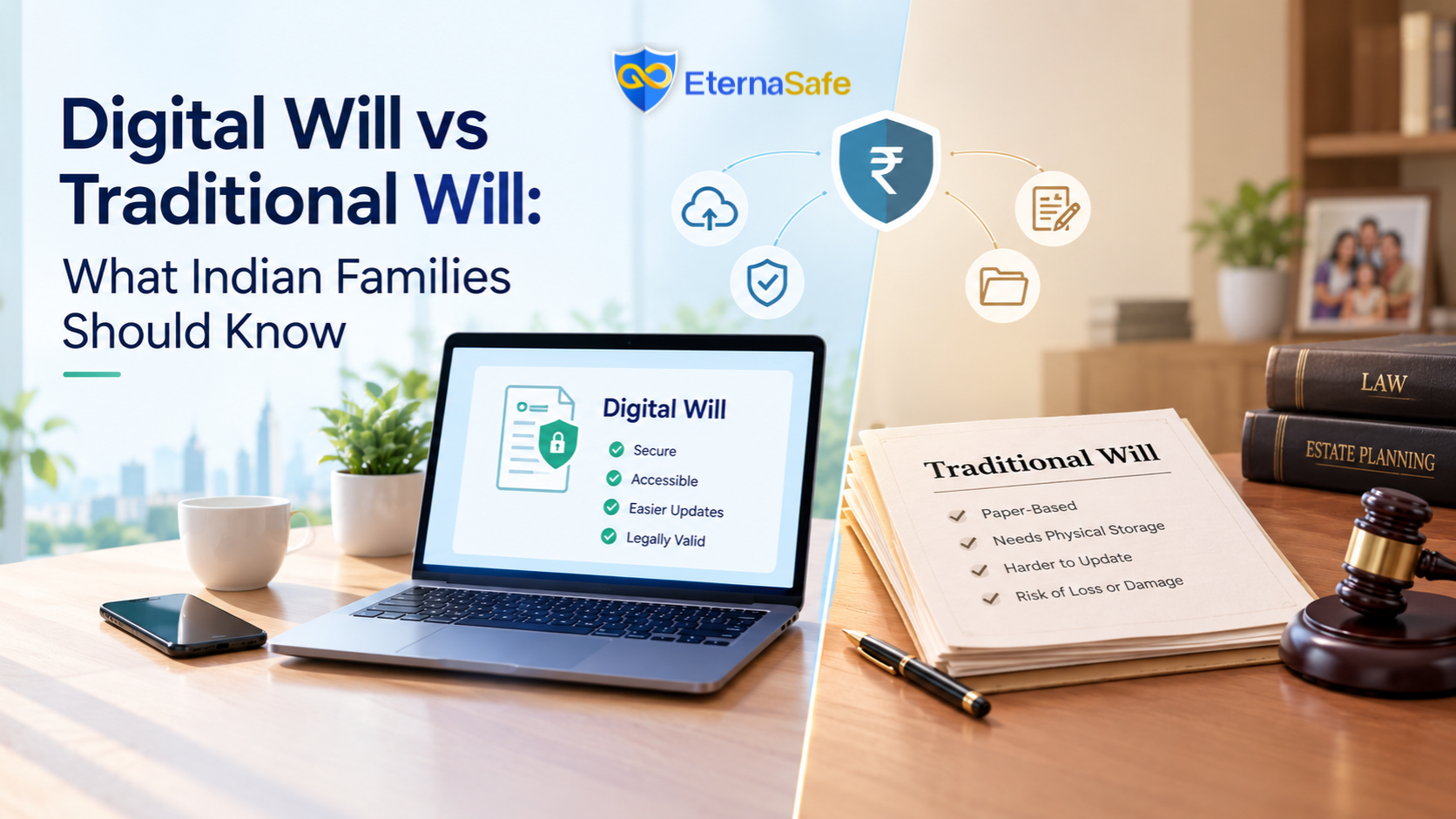
Digital Will vs Traditional Will: How They Differ
To begin with, it is important to know that the term digital may seem to be misleading.
What is a digital will? typically, a digital will refers to a will created via an online service or made in digital format, but not necessarily signed electronically. In fact, many online services for creating a will produce the document in a digital format, requiring the client to print it, finish it in front of the notary, and have it signed by witnesses.
A traditional will, on the other hand, is generally prepared through a lawyer or independently, printed and executed physically from the beginning.
The Important Distinction
There are really three different things people often call a “digital will”:
- A will drafted using an online platform and then physically signed and witnessed.
- A physical will that has been scanned and stored digitally as a backup.
- A document that is intended to be created, signed and witnessed entirely through electronic methods.
The three should not be seen as interchangeable.
The first two could involve digital tools without changing the basic execution process; meanwhile, the third raises a much more complicated legal question because this particular issue puts more pressure on the IT Act, which does not extend its electronic record and electronic signature framework to empower wills.
How a Traditional Will Works in India
While not necessarily complicated, a will is somewhat conditioned by the surrounding situation dealt with by the testator in the process of writing.
The individual who draws up a will must have the requisite testamentary ability as stipulated in the Indian Succession Act. The law is concerned with the execution and witnessing of unprivileged wills in that; the testator must sign on the will, as an act of will, in the presence of at least two witnesses who sign the will.
What Usually Happens?
A traditional estate-planning process may involve:
- Listing the person’s assets and liabilities.
- Identifying beneficiaries and family circumstances.
- Deciding how the assets should be distributed.
- Appointing an executor.
- Preparing and reviewing the will.
- Signing the document in accordance with the applicable legal requirements.
- Having the required witnesses attest the will.
- Storing the original document safely.
The advantage here is that a lawyer can ask questions that a basic form may never ask, particularly when the family situation or asset structure is complicated.
How a Digital Will Works
The use of an online will means that the friend or other loved ones are not presented with any difficulty as all the information needed to write the will can be input into an online form, the assets and beneficiaries sorted out, and a draft will be prepared.
For those with a simple financial situation, this means that the process is relatively easy and ensures that the person is less likely to experience the hesitations that may prevent them from creating a will in the first place.
What Online Platforms Usually Do
Most online will services follow a process broadly along these lines:
- Collect personal and family information.
- Ask about assets and liabilities.
- Record beneficiary preferences.
- Collect executor and witness details.
- Generate the will document.
- Allow the person to review and make changes.
- Provide the final document for execution.
The important part comes at the end.
A digital signature alone does not automatically turn the document into a valid will. Current reporting on online will services in India notes that users generally still need to print the document and execute it with the required witnesses.
Is a Digital Will Legally Valid in India?
This is where the digital will vs traditional will comparison needs some care.
In the event that you are talking about a “digital will” as a will made via the internet but executed properly in paper form, then you have nothing to worry about. Execution is different from drafting. On the contrary, if your digital will refers to a will existing only in electronic form which has been executed solely by digital signatures and processes, the situation is not that clear.
Actually, the Information Technology Act allows the use of electronic records and signatures in many transactions, yet in Section 1(4) and in the First Schedule it clearly states that wills and other testaments are not included.
In other words, even if you assume that a digitally signed PDF will be treated as if it were the same as an executed will by virtue of electronic signature use in many transactions, you are wrong.
Digital vs Traditional Will: A Practical Comparison
| Factor | Digitally Prepared Will | Traditional Will |
| Drafting | Usually completed online | Usually prepared with a lawyer or independently |
| Convenience | Can be created remotely | May require meetings and physical paperwork |
| Cost | Often lower for basic plans | Can be higher depending on professional involvement |
| Customisation | Depends on the platform | Can be tailored extensively |
| Physical execution | Usually still required | Normally part of the process |
| Witnesses | Required where applicable | Required where applicable |
| Complex estates | May need professional review | Professional advice can be built into the process |
| Digital storage | Usually easy | Can be scanned and backed up |
| Electronic-only execution | Not automatically recognised | Not applicable |
| Best suited for | Relatively straightforward estates | Complex or sensitive family situations |
The biggest takeaway from this comparison is that digital and traditional are not necessarily opposites. A person can use a digital platform to prepare a will and still end up with a physically signed and witnessed document.
When a Digital Will May Make Sense
An online approach can be useful when the main problem is getting started.
Someone who has a relatively straightforward estate, understands their assets and knows how they want those assets distributed may find a digital platform easier than arranging multiple meetings before even preparing the first draft.
It can also be useful for families that want to organise information first and then seek professional review before executing the final document.
Digital Preparation Can Help With
- Creating an initial asset inventory.
- Organising beneficiary information.
- Recording executor details.
- Preparing a first draft.
- Keeping a digital backup.
- Making future updates easier to manage.
The convenience matters because an unfinished will is not particularly useful to a family, no matter how sophisticated the estate plan was supposed to be.
When a Traditional Approach Is Better
As the estate becomes more complex, this suggests that treatment of the will as simply a document to be generated based on the inputs given may not be justified. Take, for example, the case when an online template may miss the fact that one and the same person left the same property to two different heirs in different provisions of the document, or when the property cannot be transferred as indicated in accordance with the will because the deceased does not own 100% of the title being conveyed.
According to certain recent legal recommendations, common situations such as having several properties, divorce, being married multiple times, being an expatriate or a foreigner, holding a significant stake in a closely-held company may require a professional’s support if the will is created online.
Professional Review Becomes Particularly Important When
- The family structure is complicated.
- There are multiple marriages or blended families.
- Assets are spread across countries.
- The estate includes substantial business interests.
- There are jointly owned or ancestral properties.
- A beneficiary is a minor or requires long-term support.
- One or more natural heirs are being excluded.
- The will creates a trust or other complex arrangement.
In these situations, the value of professional advice is not simply in typing the document. It is in identifying the questions that need to be answered before the document is signed.
What About Digital Copies of Traditional Wills?
Equipment used for collecting digital copies of files, such as document scanners, computers, and smartphones, can be of great help in creating a digital version of a paper will.
Once the physical will has been executed properly, the family will have access to what the documents say and where the original one is.
One of the benefits is the avoidance of situations when a family finally finds out about the existence of a will but does not have any idea about its whereabouts.
However, it is critical to understand that a digital copy is a backup, not a substitute for the original will.
Keep Track of the Original
The family should ideally know:
- Where the original will is stored.
- Who the executor is.
- Whether a later will or codicil exists.
- Which version is the latest.
- How the executor can access the relevant estate information.
This becomes particularly important because a dispute over a will can involve questions around execution, testamentary capacity, coercion and other circumstances surrounding its creation. Registration itself does not provide absolute protection from a later challenge.
What About Digital Assets?
There is another reason the conversation around digital wills is becoming more relevant.
A contemporary property has the ability to include possessions and accounts which were not discussed in previous estate planning discussions such as domain names, online businesses, social media accounts, cloud storage, cryptocurrency and digital investment platforms.
Indian law does not yet have one law governing how to deal with every type of digital asset after death, which indicates that people need to think about not only the asset which is in question.
That is why preparation of a will can be a part of an overall digital estate plan but it should not be considered a mere password list.
Which Will Should Indian Families Choose?
There is no clear winner in the argument of digital will vs traditional will because the right choice depends on the person, the estate and the complications involved.
For someone with a simple estate, preparing a will digitally may help reduce the difficulty of the process, especially if the service he/she chooses gives the chance to review the document properly beforehand.
In the case of someone possessing valuable property, with complex family arrangements, overseas holdings, business interests or high risk of disputes, it may be smarter to use the lawyer-assisted approach because the conversation can go beyond basic filling in.
And of course there are no restrictions preventing families from utilizing both options.
The Practical Middle Ground
For many families, the most sensible model is:
Digital preparation + professional review where required + proper physical execution + secure digital recordkeeping.
This gives people the convenience of digital tools without assuming that technology has replaced the legal requirements surrounding wills.
What Families Should Check Before Signing a Will
Regardless of whether the first draft came from a lawyer, an online platform or the person’s own computer, the final review deserves serious attention.
Before signing, check whether:
- All major assets have been identified correctly.
- The ownership of each asset is clear.
- Beneficiaries are correctly named.
- The executor is willing and able to take on the role.
- Backup beneficiaries have been considered.
- The instructions do not contradict one another.
- The latest version can be clearly identified.
- The signing and witnessing process follows the applicable legal requirements.
It is also worth reviewing the will after major life events rather than assuming that a document prepared ten years ago will continue to reflect the family’s circumstances.
Conclusion
People often present the issue of digital will vs traditional will as a choice between old-school paperwork and modern technology but that’s not really what families in India are thinking about.
Digital platforms allow a quick start to the estate planning process, smooth organisation of assets and creating a draft; on the other hand, legal aspects must be considered when signing a will. It is important to remember that the Information Technology Act specifically excludes wills meaning that families can’t assume that the electronic signature can automatically replace the traditional will execution process that has been used for years.
In the case of an uncomplicated estate, the online platform provides a means of convenience while the complicated one may require an attorney to examine the document and the surrounding situation. Nevertheless, the main goal remains the same: to make sure that your family has a clear and valid record of your wishes ready to use when they need it.
For families that used EternaSafe, the will can be used as a part of a wider legacy plan in which all significant estate-related information, asset lists, and instructions are systemised for the help of the remaining relatives.
FAQs
Is a digital will valid in India?
A will prepared using digital tools can be valid if the resulting document is properly executed according to the applicable legal requirements, but an electronically signed document should not automatically be treated as a valid will because wills are specifically excluded from the IT Act’s electronic framework.
Is a traditional will better than an online will?
Neither is automatically better, because the important issue is whether the will properly reflects the person’s circumstances and has been validly executed, although complex estates may benefit considerably from personalised professional advice.
Can I create my will online and then print it?
Yes, this is how many online will-making services operate, with the document being prepared digitally and then printed, signed and witnessed according to the applicable requirements.
Does a digital signature make a will valid?
A digital signature by itself does not automatically make a will legally valid in India because wills are excluded from the electronic-signature framework of the Information Technology Act and separate requirements apply to wills.
Should I keep a digital copy of my traditional will?
Keeping a secure digital backup can be useful, but the family should also know where the original executed document is stored and which version represents the person’s latest valid wishes.