Having a baby changes the way you look at money, completely. Earlier, you may have been planning your savings around buying a house, taking a holiday, changing jobs or building a comfortable retirement, but once a child enters the picture, even the smallest financial decision starts to feel a little different. You begin thinking about hospital bills, future school fees, daily expenses and how you will manage everything if one parent has to take a break from work.
Most new parents start by checking their health insurance or buying a life insurance policy, which is an important step because a medical emergency or the loss of an earning parent can put the family’s finances under serious pressure. But insurance alone cannot take care of every responsibility that comes with raising a child. You also need savings that you can access when required, a plan for future education expenses, updated legal documents and a clear record of your family’s financial information.
This is where a new parent financial checklist becomes useful, because it helps you look at the bigger picture instead of making financial decisions one at a time whenever a new expense comes up.
For example, imagine that both parents are working and most of the household expenses are managed through their monthly salaries. If one parent has to stop working for several months, the family may need to manage medical costs, childcare expenses, loan payments and regular household bills with a lower income. Even if the family has life insurance, that policy may not help with every short-term expense, especially if the situation does not involve the death of the insured person.
So, what should new parents actually do to protect their child’s future? Well, the answer is not to buy every financial product available or start saving an unrealistic amount from the first month. It is about building a practical system that protects the family today while preparing for the child’s needs in the years ahead. Let’s take a look at the steps that deserve your attention.
Why New Parents Need a Financial Plan Beyond Insurance
Insurance protects against certain financial risks, but raising a child involves several responsibilities that do not fall under one policy. You need money for regular expenses, funds for unexpected situations, long-term savings and a plan for managing important decisions if you are not available to make them yourself.
Consider the difference between these situations:
- Your child needs medical treatment that is not fully covered by your health insurance.
- One parent takes an extended career break, reducing the household’s monthly income.
- A parent passes away, and the surviving parent needs to manage the child’s expenses while handling financial and legal paperwork.
- Both parents are unavailable during an emergency, and another trusted adult needs to know how to access essential information.
- Education costs rise over the next 15 years, and the family has not started saving towards them.
Each situation requires a different kind of preparation. An insurance policy may help in some circumstances, savings may help in others, and properly organised documents can make it easier to handle decisions when time is limited.
A good financial plan connects these pieces rather than treating them as separate tasks.
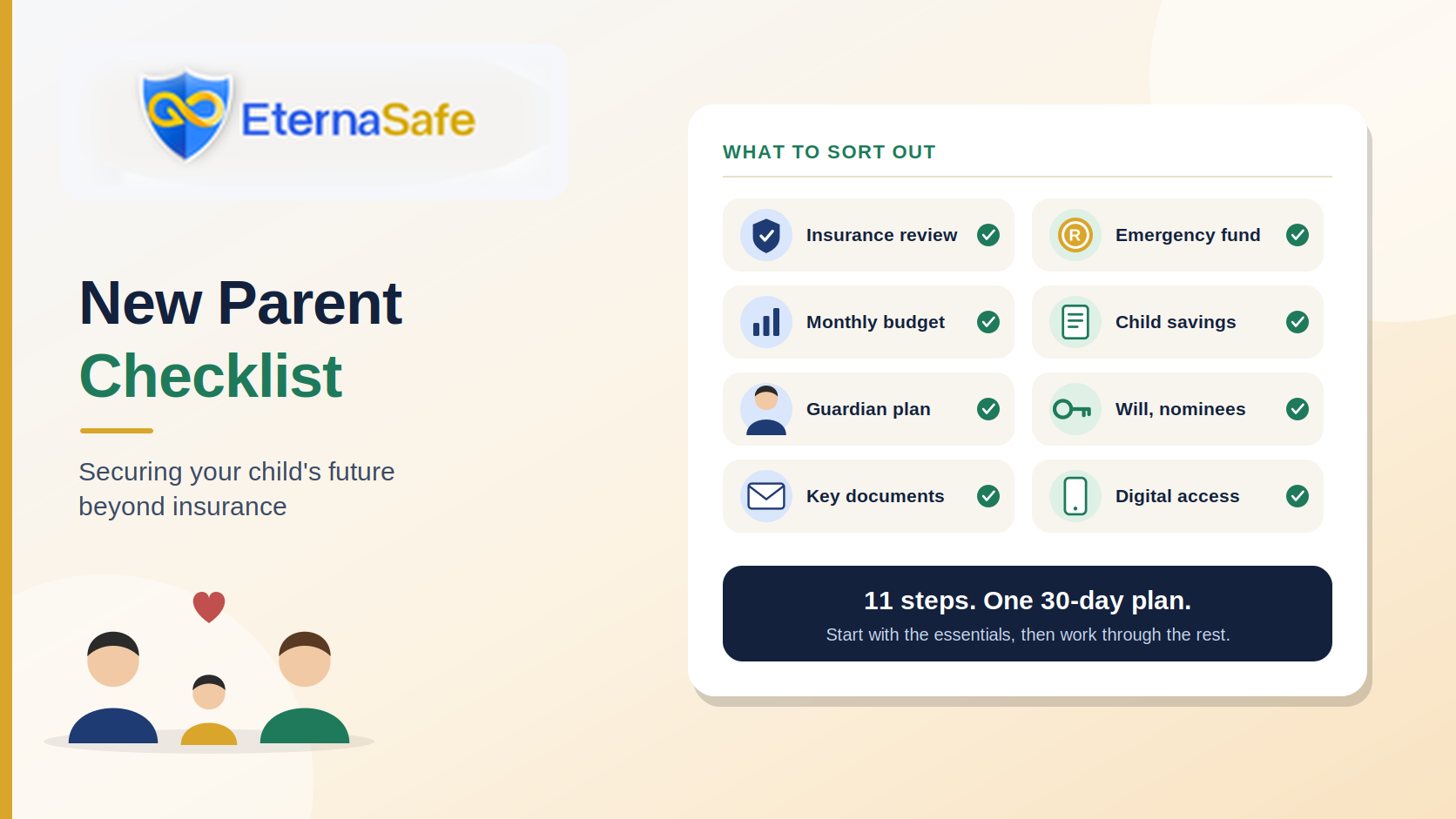
Your New Parent Financial Checklist
The following checklist covers the areas new parents in India should review, from immediate household finances to long-term planning and document organisation. You do not have to complete everything in one weekend, but it helps to know what needs attention and what can be handled over the next few months.
1. Review Your Health and Life Insurance
Insurance is an important starting point, but the goal is to understand what your existing policies actually cover instead of assuming that you are protected because you already have them.
Check your health insurance coverage
Start by reviewing your current health insurance policy and understanding how it applies to your family after the birth of your child. Check whether your newborn needs to be added to the policy, the applicable deadlines, the coverage available and whether any waiting periods or exclusions apply.
If you have employer-provided health insurance, confirm what happens if you change jobs or take an extended career break. Employer coverage can be useful, but relying on it as your family’s only health protection may leave you exposed if your employment circumstances change.
Also review the following:
- Hospitalisation limits, room restrictions and applicable co-payments.
- Coverage for your child’s medical needs and any relevant waiting periods.
- Whether your policy includes restoration benefits or other limits that could affect a large claim.
- How to contact the insurer and submit a claim during an emergency.
Read the actual policy wording because benefits and conditions vary between insurers and plans.
Review life insurance for both parents
Life insurance is not only a consideration for the parent who earns more. If either parent dies, the surviving parent may face additional childcare expenses, a reduction in household income or the cost of arranging help at home.
When reviewing your cover, consider outstanding loans, regular household expenses, future education costs and the financial support your child may need until adulthood. Existing savings and other assets also matter, so the amount of cover should be based on your family’s actual financial situation rather than an arbitrary number.
A term life policy may be suitable for some families, but compare the coverage, exclusions, premium affordability and policy duration before making a decision.
Do not overlook disability and income protection
A parent does not have to pass away for a family’s finances to be affected. An illness, accident or other health problem may prevent someone from working for an extended period, while household expenses continue.
Check whether your employer provides relevant benefits and whether any individual disability or income protection options are available and appropriate for your circumstances. Understand exactly what qualifies for a payout and how long the benefit lasts.
The aim is to identify the risks your current insurance does not cover, rather than buying multiple policies without understanding what each one does.
2. Build an Emergency Fund for Your Growing Family
Before focusing heavily on investments for your child’s future, make sure you have money available for unexpected expenses.
A new baby can bring additional costs that are difficult to predict, including medical appointments, medicines, childcare, travel to visit family and temporary changes in income. Even when the family has insurance, some expenses may need to be paid before reimbursement or may not be covered at all.
A useful starting point is to work towards an emergency fund covering three to six months of essential household expenses. Families with irregular income, a single earning parent or substantial financial responsibilities may need a larger reserve, depending on their circumstances.
For example, if your essential monthly expenses are ₹50,000, an initial target of ₹1.5 lakh to ₹3 lakh would cover three to six months of those expenses. This is an illustrative target, not a fixed rule for every family.
What should your emergency fund cover?
Your emergency fund should be available for situations such as:
- Temporary loss of income or an unexpected career break.
- Medical expenses that are not covered by insurance.
- Essential childcare or support at home during an emergency.
- Urgent household repairs or necessary travel.
- Loan payments and other essential commitments during a difficult period.
Keep this money somewhere accessible and relatively stable, such as an appropriate savings account or another suitable low-risk, liquid option. Avoid putting the entire emergency fund into investments that may fluctuate significantly in value or take time to access.
If saving several months of expenses feels difficult right now, start with a smaller target and build it gradually. The important thing is to create a separate reserve rather than relying on credit cards or personal loans whenever something unexpected happens.
3. Rework Your Monthly Budget After the Baby Arrives
Your old household budget may no longer reflect how your money is being spent. Even if your income has not changed, your expenses may look very different after adding childcare, medical needs and everyday supplies for your child.
Instead of guessing how much you need, track your actual spending for the first few months and use it to prepare a more realistic budget.
Your revised budget should include:
- Essential Household Expenses: Rent or home loan payments, groceries, utilities and transport.
- Baby-Related Expenses: Healthcare, feeding supplies, clothing, hygiene products and other recurring needs.
- Childcare Expenses: Daycare, a caregiver or additional household support where required.
- Financial Commitments: Loan EMIs, insurance premiums and existing family obligations.
- Future Savings: Emergency fund contributions, education savings and retirement investments.
- Flexible Spending: Non-essential purchases, entertainment and other expenses that can be adjusted when needed.
You should also plan for the possibility that one parent may take unpaid leave, reduce working hours or temporarily stop working. This can affect both monthly income and long-term savings, including retirement contributions.
Try preparing two versions of your budget: one based on your current household income and another based on a temporary reduction in income. This makes it easier to see which expenses can be reduced and how much financial support you may need if circumstances change.
4. Start Saving for Your Child’s Future
Education, extracurricular activities and other opportunities can become significant expenses as your child grows. You do not need to predict every future cost, but you can begin building a savings habit early.
The main advantage of starting early is that you have more time to contribute towards your goal. However, choosing the right savings option requires more thought than simply opening an account in your child’s name.
Set a clear education savings goal
Start by identifying the expenses you want to prepare for. These could include school fees, higher education in India, overseas education or other major goals.
Estimate the future cost rather than using only today’s fees. Education expenses may rise over time, so inflation should be considered when setting your target.
For example, if your child is a newborn and you expect to need the money when they turn 18, you have a long investment horizon. This gives you time to consider different savings and investment options, depending on your risk tolerance and financial situation.
Compare savings and investment options
Different options serve different purposes, and no single account or investment is automatically right for every family.
| Option | What to consider |
| Savings account | Useful for accessible money and short-term needs, but returns may not keep pace with inflation |
| Fixed deposit | Offers a defined interest rate for a chosen tenure, subject to the terms and applicable tax treatment |
| Public Provident Fund (PPF) | A government-backed long-term savings scheme with specific contribution, withdrawal and maturity rules |
| Mutual funds | Can provide exposure to different asset classes, but market-linked returns are not guaranteed |
| Other eligible savings schemes | May offer specific benefits or restrictions, so check eligibility, tenure and withdrawal rules |
A parent or eligible guardian can open a PPF account on behalf of a minor under the scheme’s rules. However, remember that PPF has a long maturity period and specific rules for deposits and withdrawals, so it may not be suitable for every education goal. You can review the scheme details through the National Savings Institute or the government’s myScheme portal.
Before choosing any product, check the current rules, charges, tax treatment, risk level and access to the money. Do not put every rupee meant for your child’s future into one product simply because it is marketed as a child plan.
Keep your child’s savings separate from everyday spending
It helps to maintain a clear record of the money you are setting aside for your child’s future. This does not necessarily mean you need multiple accounts or complicated investments, but you should know how much you have saved, where it is held and what the money is intended for.
If you open an account in your child’s name, understand the rules governing its operation, including what changes when the child reaches adulthood. RBI guidance allows minor deposit accounts to be operated through a natural or legally appointed guardian, subject to applicable banking rules and the bank’s requirements.
5. Make a Plan for Your Child’s Guardian
This is one of the most important parts of family planning, and it is often delayed because parents assume they will deal with it later.
If both parents become unavailable due to death or another serious situation, who would care for your child? Who understands the child’s routine, healthcare needs and education plans? Who would know where the important records are kept?
These are difficult questions, but discussing them early can reduce uncertainty for the people who may need to step in.
Choose a trusted person and discuss the responsibility
Think carefully about who could provide a stable and supportive environment for your child. Consider their relationship with the child, their willingness to take on the responsibility, their circumstances and whether they share your broad approach to the child’s upbringing.
Do not assume that a relative will automatically be ready or able to take on this role. Have an honest conversation first, explain your expectations and consider whether a backup arrangement is appropriate.
Understand the legal process
Parents should seek appropriate legal advice about how guardianship wishes can be documented and what the law requires in their particular circumstances. A will may be relevant to expressing a parent’s wishes, but its effect and the appointment of a guardian depend on the applicable law and facts.
Avoid relying only on a verbal promise or assuming that naming someone informally settles every legal question. If your family situation is complex, consult a qualified legal professional to prepare the necessary documents.
6. Prepare or Update Your Will and Estate Planning Documents
A will is not only for people who own several properties or have substantial investments. New parents may have bank accounts, insurance policies, retirement savings, investments, vehicles and other assets that need to be identified and managed if they die.
Without a clear plan, the family may have to spend time locating assets, understanding ownership and following the relevant legal procedures at an already difficult time.
What should you consider documenting?
Depending on your circumstances, review whether you need to prepare or update:
- A will that addresses the distribution of your assets.
- Your wishes concerning the care of your minor child, with appropriate legal advice.
- A current list of financial assets, liabilities and relevant institutions.
- Details of insurance policies and the beneficiaries or nominees recorded with the provider.
- Information about property ownership, loans and other important financial commitments.
- Instructions on where the original documents are stored and how the relevant institutions can be contacted.
A will, a nomination and a guardianship arrangement do not all serve the same purpose. Their legal effects can differ depending on the asset and the applicable law, so do not assume that completing one automatically takes care of the others.
If you already have a will, review it after the birth of your child. A major family change is a practical reason to check whether your existing documents still reflect your wishes.
7. Review Nominees and Beneficiary Details
Opening an insurance policy or investment account is only one part of keeping your financial records up to date. You should also review the nominee and beneficiary details recorded with the relevant institutions.
For example, you may have purchased an insurance policy years before your child was born. The person recorded in the policy may no longer reflect your current family circumstances, or the information may be incomplete.
Review the nomination rules for each relevant account or policy and ask the provider how changes should be made.
Pay attention to:
- Life insurance policies.
- Bank accounts and fixed deposits.
- Mutual funds and eligible investment holdings.
- Retirement accounts and other financial benefits.
- Any other asset where nomination or beneficiary details are relevant.
Do not assume that adding your child as a nominee automatically makes every asset straightforward to manage, particularly while the child is a minor. Depending on the product and circumstances, additional legal or administrative arrangements may be needed.
Keep a record of when you reviewed each nomination and where the latest confirmation can be found. It is also worth checking these details after major life events, including the birth of another child, marriage, separation or the death of a family member.
8. Organise Your Child’s and Family’s Important Documents
This is where many families discover a problem they did not expect. They may have insurance, savings and a will, but the documents explaining those arrangements are spread across different places.
A birth certificate may be in a physical folder, health records may be stored in an email account, insurance documents may be available through an app, and details about a bank account may exist only in one parent’s memory.
This is why document organisation should be part of your new parent financial checklist rather than something you do only when a document is requested.
Create a central record of important documents
Start by making a list of the documents your family may need, including:
- Your child’s birth certificate and relevant identity documents.
- Health insurance details and important medical records.
- Vaccination records and information about healthcare providers.
- Parents’ identity documents and contact information.
- Insurance policies, bank account details and investment records.
- Property papers, loan details and other major financial documents.
- Your will and relevant estate planning paperwork.
The list will vary from family to family, so include what is relevant to your circumstances rather than collecting unnecessary copies of every record.
Keep originals safe and digital copies accessible
Original documents should be stored in a suitable physical location where they are protected from avoidable damage and can be retrieved when necessary. Digital copies can make it easier to find information quickly, especially if you are travelling or need to share a record with an authorised person.
However, a scanned copy does not replace an original document in every legal or administrative situation. Check the requirements of the institution or authority that needs the document.
For digital storage, use a trusted service, strong passwords and multi-factor authentication where available. Review who can access or share the records, and make sure you understand the platform’s recovery arrangements.
Make sure a trusted person knows where to look
Organising the documents is not enough if nobody else knows that the records exist. A trusted person should know where the essential information is stored and how to contact the relevant institutions if you are unavailable.
This does not mean sharing every password or giving unrestricted access to all your accounts. Instead, prepare a clear record of document locations, important contacts and the steps someone may need to follow in an emergency.
EternaSafe can be considered as part of this family document organisation process, particularly when you are reviewing how important digital records and estate planning information are kept together. Before storing sensitive information on any platform, check its available features, access controls and recovery options to make sure they suit your family’s needs.
9. Plan for Childcare, Education and Other Future Expenses
Your child’s financial needs will change as they grow, so your plan should not focus only on the first year after birth.
In the early years, expenses may include childcare, healthcare and everyday supplies. Later, you may need to budget for school fees, activities, technology, transport, tutoring or higher education.
Instead of treating every expense as a surprise, identify the major stages and decide how you will prepare for them.
Estimate future expenses early
Create a simple timeline of the costs you expect to face over the next few years. You do not need exact numbers for every year, but having a broad estimate can help you decide how much to save and when you may need the money.
For example, money required for school fees in the next two years should usually be managed differently from investments intended for higher education 15 years away. The first goal requires greater attention to short-term access and stability, while the longer-term goal may allow you to consider a wider range of investment options.
Keep your own retirement plan in the picture
Parents sometimes prioritise their child’s future so heavily that they stop contributing to their own retirement savings. This can create another financial problem later, because parents may eventually need to depend on their children for support.
Your child may need help with education and other opportunities, but your long-term financial security matters too. Try to balance education savings with retirement contributions, essential insurance and your emergency fund instead of funding one goal by neglecting everything else.
10. Protect Your Family’s Digital and Financial Access
A growing share of family finances is managed online. Bank accounts, insurance policies, investment platforms, utility bills and medical records may all require digital access, which can make things difficult if the person who manages them becomes unavailable.
You do not need to share all your passwords with your partner or another family member, but you should have a safe and practical way to manage essential information.
Start by identifying which services your household depends on and how someone would locate the relevant account or contact the provider if necessary.
Review the following:
- Which bank accounts are used for household expenses.
- Where insurance and investment records can be found.
- Which recurring bills are paid automatically.
- How to contact financial institutions if an account holder dies or becomes incapacitated.
- Where recovery instructions and essential account information are stored.
- Which trusted person should be informed about the location of important records.
Use secure password management practices and avoid keeping banking passwords, PINs or OTPs in an ordinary document alongside your family records. Where an institution has a formal process for authorising another person, follow that process rather than assuming a family relationship automatically grants access.
11. Set Up a Simple Financial Review Routine
Once the main tasks are complete, the next step is to make sure your plan does not become outdated.
You do not need to review every document every week. A simple routine can help you keep things in order without turning family finances into another full-time responsibility.
Every month
- Review your household spending and recurring baby-related expenses.
- Check whether you can make your planned savings contributions.
- Replenish your emergency fund if you have used it.
Every six months
- Review your savings goals and upcoming childcare or education expenses.
- Check that important records are still accessible.
- Confirm that your household budget reflects any changes in income or expenses.
Once a year, or after a major life event
- Review health and life insurance coverage.
- Check nominees and beneficiary details where applicable.
- Review your will and other estate planning arrangements with a qualified professional when needed.
- Update your list of assets, liabilities and important documents.
- Confirm that the trusted person you have chosen knows where essential records are kept.
This routine is particularly useful when the family grows, you buy a property, change jobs, move to another city or experience a significant change in income.
A Practical 30-Day Plan for New Parents
If the full checklist feels like too much to manage at once, break it into smaller tasks. The following plan gives you a starting point without requiring you to make every financial decision immediately.
| Timeline | What to do |
| Week 1 | Review health insurance, check newborn coverage requirements and list your current household expenses |
| Week 2 | Set an emergency fund target, review life insurance and identify gaps in your current protection |
| Week 3 | Start an education savings plan, review nominations and discuss guardianship wishes with a trusted person |
| Week 4 | Organise important documents, review your will and create a simple record of assets, liabilities and key contacts |
Some tasks, particularly legal documentation and insurance changes, may take longer depending on your circumstances. The purpose of the 30-day plan is to get started and identify the next steps, not to rush decisions that need careful consideration.
Conclusion
Becoming a parent brings a new set of financial responsibilities, but preparing for them does not mean you have to solve every future problem immediately. What matters is building a practical system that helps you manage today’s expenses, deal with unexpected situations and make steady progress towards your child’s future needs.
Use this new parent financial checklist to review your insurance, build an emergency fund, organise your monthly budget, start saving for education and make sure your legal documents and financial records reflect your current family situation.
And remember, protecting your child’s future is not only about how much money you save. It is also about whether your family can locate important documents, understand the arrangements you have made and take the right steps if something unexpected happens.
Start with the essentials, work through the remaining tasks at a pace that suits your circumstances and review your plan as your child grows. A little organisation now can make important financial decisions much easier for your family later.
Frequently Asked Questions
What should be included in a new parent financial checklist?
Include health and life insurance, an emergency fund, a household budget, education savings, guardianship planning, a will, updated nominations and organised family documents.
How much should new parents save for emergencies?
A common starting point is three to six months of essential expenses, with a larger reserve considered if income is irregular or financial responsibilities are higher.
Should new parents start saving for their child’s education immediately?
Starting early gives you more time to build savings, but first consider essential expenses, high-cost debt, insurance needs and an adequate emergency fund.
Do new parents in India need a will?
A will can help document your wishes regarding your assets and may be relevant to planning for a minor child’s care. Seek legal advice about the requirements that apply to your situation.
Should I open a bank account in my child’s name?
A minor account may be useful for managing money intended for your child, but check the bank’s requirements, guardian arrangements and rules for operating the account.
Is health insurance enough to protect my child financially?
Health insurance can help with eligible medical expenses, but it does not replace emergency savings, life insurance planning, education savings or legal and document preparation.
How often should parents update their financial documents?
Review them at least annually and after major life events, such as the birth of another child, a property purchase, a job change or a significant change in family circumstances.
Why should new parents organise important family documents?
Organised records help parents and trusted family members locate insurance policies, financial assets, medical information and legal documents when they are needed, including during emergencies.