Short answer: partly. Nominees work well for bank accounts and investments, but they were never designed for your email, photos or wallet. Here is how to cover the gap.
Most of us have filled in a nomination form at some point. A bank clerk slid it across the desk, you wrote a name, signed, and moved on. Job done, you assumed.
Then life got more digital. Now your money sits in a demat app, your policies in a portal, your photos in the cloud and your email holds the keys to all of it. So it’s fair to ask whether that old nomination still covers you, and whether you can nominate someone for the digital side of your life too.
The honest answer has two halves. For financial accounts, yes, and the rules have recently improved. For everything else, there isn’t one tidy form, which is why a little planning matters.
What A Nominee is, And What A Nominee is Not
A nominee is the person you name to receive or deal with an account if you die. It’s a simple idea, and it’s easy to misread.
Being named as a nominee doesn’t automatically make someone the owner of the money. In many cases the nominee is the first person the institution will deal with, a sort of safe pair of hands, while the legal heirs, the people entitled under a Will or succession law, may still have a claim. That’s why families sometimes find that a nominee received the funds and then had to settle the question of who else was entitled.
The simplest way to remember it: a nomination tells an institution who to talk to. A Will tells the world who gets what. You need both to be clear. If you haven’t set up a Will yet, our explainers on what a digital will is and how to make an online will in India are a good place to begin.
Where Nomination Works Well
For most financial accounts, nomination is built in. Banks, demat accounts, mutual funds, insurance policies and provident fund accounts all let you name someone. The details vary from product to product, so it’s worth checking each one rather than assuming.
There has been one welcome change. Under the Banking Laws (Amendment) Act, 2025, bank customers can name up to four nominees from 1 November 2025, either together or one after another. That’s a real improvement for families with more than one person who might need to step in.
If a bank account is your main worry, our guide on what happens to your bank account after death explains the claim steps in plain language.
The practical point is this: nomination only works if it exists and is up to date. Many people last filled one in years ago, before a marriage, a child, or a parent passing away.
Where Nomination Stops
Here is where it gets harder. Your email account, cloud storage, social media and crypto wallet aren’t covered by a bank-style nomination. They sit under each company’s own rules.
Some platforms offer their own version. Google lets you name trusted contacts who can get access after your account has been inactive for a period you choose. Apple lets you add a Legacy Contact, who can request access with a death certificate. Social platforms tend to offer memorialising or closing an account, rather than handing it over.
These tools are useful, and you should set them up. But each works only inside its own app. They don’t tell your family that you have a mutual fund with a particular fund house, that your provident fund is held in two places, or that your business domain renews every March.
Crypto is the sharpest example. If you hold coins in a wallet you control, a nominee form can’t help, because the access lives in a private key or recovery phrase. Whoever knows it controls the asset, and if nobody does, it may be lost for good.
There’s also a legal angle on data. The Digital Personal Data Protection Act, 2023 gives you the right to nominate someone to exercise your data rights if you die or become unable to act. It’s a welcome step, though it doesn’t create a way to hand over your accounts, and how it works day to day will become clearer as the rules take effect.
The Real Gap: Knowing What Exists
When you look at all of this together, the main problem isn’t who your nominee is. It’s whether they know what to ask for.
A nominee can’t claim an account they’ve never heard of. That’s why so many deposits end up unclaimed. As of 28 January 2026, about ₹72,454 crore of unclaimed bank deposits was sitting in the RBI’s Depositor Education and Awareness Fund, and the government now encourages people to search for them through the UDGAM portal. In most of those cases, someone loved the account holder and simply didn’t know.
This is where digital asset management comes in. If you’ve wondered what digital asset management is, you may have met the business version, which means software for organising a company’s brand files. For a household it means something simpler: a clear record of what you own and where, plus a decision about who may see it when you can’t act. In other words, it’s the missing step between filling in a nomination form and your family actually finding the account.
How To Choose Who To Nominate
When you name people, resist the urge to pick whoever comes to mind first. A few honest questions help.
Would this person stay calm and organised under stress? Do they live reachable, or are they abroad or travelling often? Are they likely to be around in ten or twenty years? And can you tell them about this without it becoming an awkward conversation?
Many people name one person and no backup. If you can, name a second, and talk to them both. The most valuable thing a nominee can have is a heads-up, even a short one: “I’ve put you down, and here’s where things are.”
For different parts of your life you may reasonably choose different people. A spouse might be the natural nominee for bank accounts, while an adult child who is more comfortable with technology handles the email and photographs. What matters is that it’s deliberate and written down somewhere.
A Simple Digital Asset Management Strategy For Nominees
A workable digital asset management strategy for nominees doesn’t require anything fancy. It comes down to four habits.
First, keep one list of your accounts, what each is for, and who is the named nominee. Second, review it once a year, perhaps on your birthday or at the start of the financial year. Third, use the legacy settings on the platforms that offer them. And fourth, make sure at least one trusted person knows how to reach the list when needed. Our 12 emergency documents checklist is a handy companion for the paperwork side.
If you’d rather not run this by hand, that’s where tools come in. Digital asset management solutions vary a lot, so look closely at what they’re built for. A typical digital asset management system for companies is designed to share files among many people. A personal digital asset management platform for a family should do almost the reverse: keep a few very private records hidden, and release them only to the right person, at the right time, after the right checks.
How EternaSafe Handles Nominees
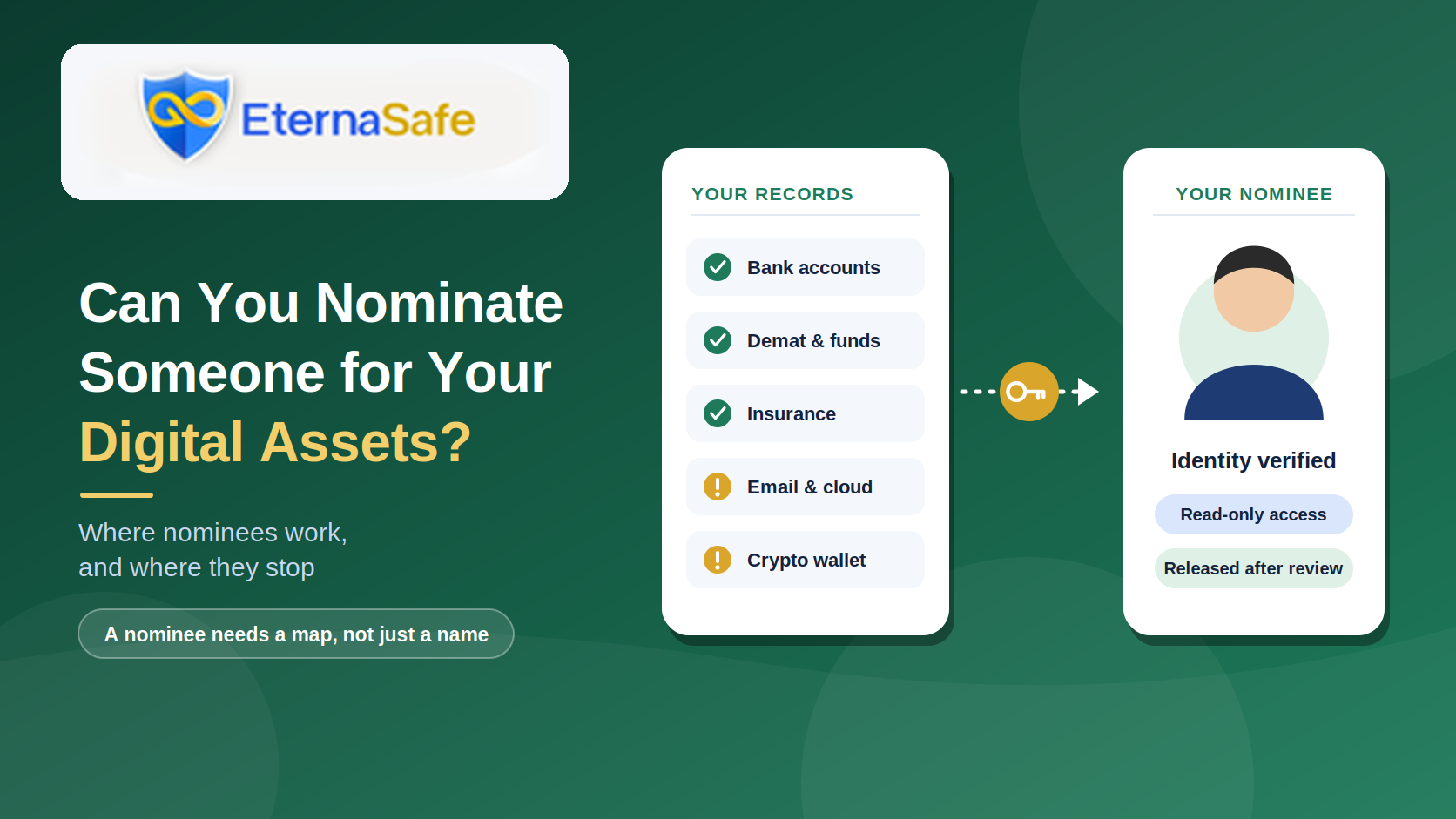
EternaSafe was built around that idea. You gather your insurance, investment and account details in one place, add digital assets such as email, cloud and crypto notes, and name up to three nominees. Each nominee is identity-verified, and their access is read-only.
While you’re alive, nominees can’t see anything. If you stop responding for a period, the platform first sends alerts to you, and any login from you cancels the process. Only if it continues does a nominee get to verify their identity, and a person reviews the request before anything is released. Nothing happens automatically.
We should be upfront about two things. EternaSafe is not an insurance product, even though we describe it as Information Insurance for your loved ones. We use the phrase because it protects your family’s access to information, not their finances. It’s also no substitute for a Will or for proper legal advice. And, as with any encrypted service, if you lose both your password and your recovery key, we can’t get your information back for you. That’s the trade-off of keeping your records private.
One Conversation Worth Having
If you do one thing after reading this, make it a conversation. Tell the person you’ve nominated that they’re the one, and where to look. It doesn’t need a ceremony. Five minutes over a cup of chai will do more than a stack of forms nobody can find.
Nomination forms tell institutions who to call. A clear record, shared with the right person, tells your family where to begin. You’ll want both.