When you pass away, your email, investments, images, and any crypto that you may have don’t cease to exist; however, it can become difficult for your relatives to access them. In this article, we will explain how, and what you can do to prevent it from happening. Consider the last time you paid a bill or verified a mutual fund. There is a good chance you did this on your smartphone, using a password, without handling any paper document.
That’s convenient while you’re around. It’s a different story when you’re not. In most Indian homes, the papers a family would once have found in a cupboard now live in apps, inboxes and online accounts. The people left behind often don’t know those accounts exist, let alone how to open them.
This isn’t a morbid topic once you see it as a practical one. It comes down to a simple question: if something happened to you, could your family find what you own? Let’s walk through what really happens to digital assets after death in India, and what a sensible plan looks like.
What Counts As A Digital Asset
The term seems to be unnerving in its character but is easy to grasp. Digital assets cover satisfactory values existing on internet and in devices despite whether it is money , memories or access.
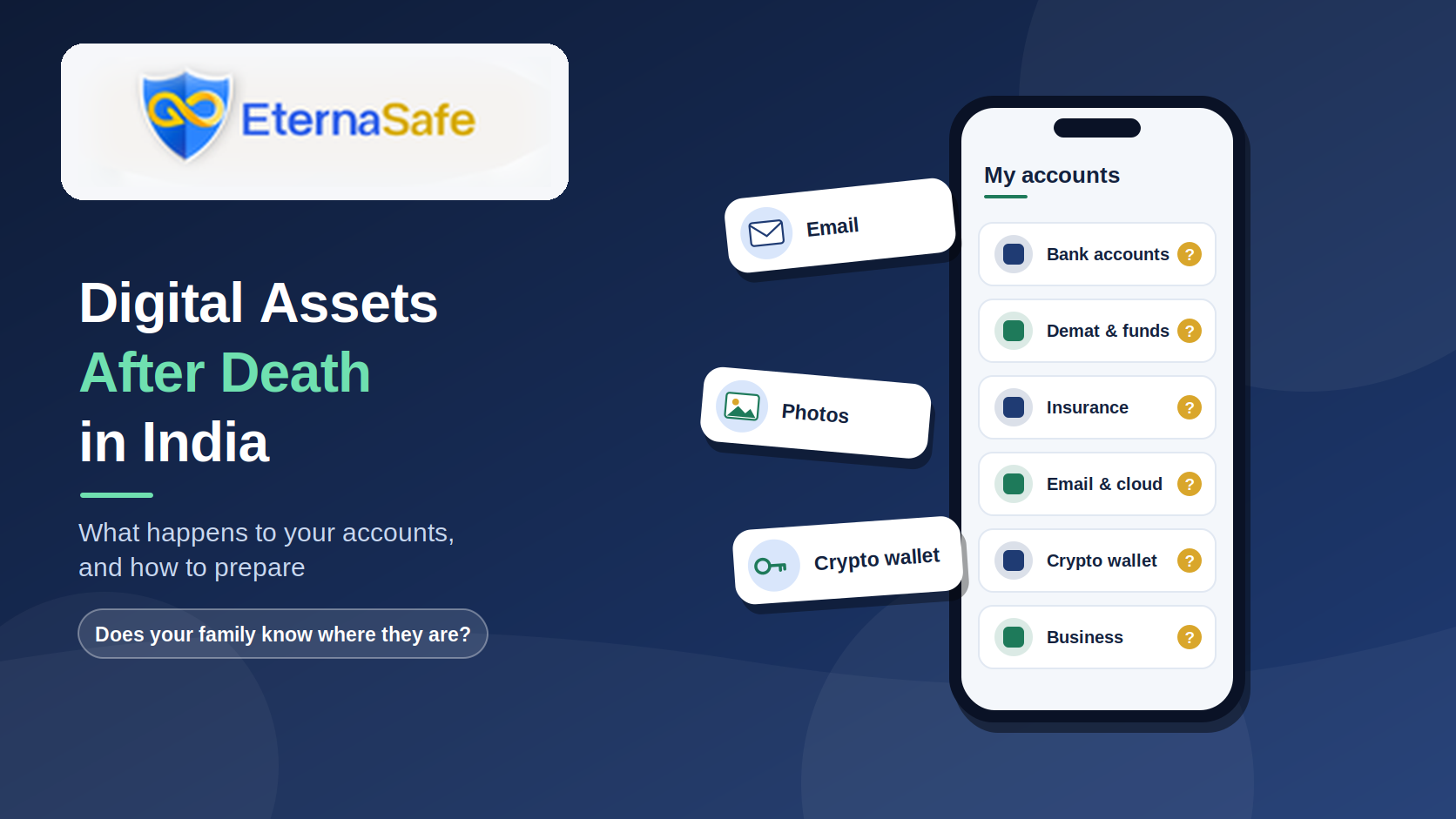
Financial ones include bank and demat accounts, mutual funds, insurance policies, EPF and NPS records, and cryptocurrencies kept either in exchanges or wallets. On the other hand, non-financial ones include email, cloud storage, photographs, messages and social media accounts. Finally, business-related digital assets include a domain name, GST login, accounting software, online shop or youtube channel making money.
A few don’t look like assets at all until they’re missing. A subscription that keeps billing a card. A phone that holds the second-step code for everything else. The point is that these things are connected, and losing one door often locks several others.
So What Actually Happens When Someone Passes Away
There’s no single rule, because every platform has its own. That’s really the heart of the problem. A bank follows banking rules, a mutual fund follows investor rules, and your email provider follows its own terms of service.
Bank and investment accounts. These are the most structured. Banks, fund houses and depositories have claim processes that involve the nominee or the legal heirs, a death certificate and some paperwork. The catch is that the family has to know the account exists in the first place. Our guide on what happens to your bank account after death walks through that process step by step.
When accounts go unnoticed, the money doesn’t vanish, it moves. As of 28 January 2026, unclaimed bank deposits held in the RBI’s Depositor Education and Awareness Fund stood at about ₹72,454 crore. The government now points people to the UDGAM portal to search for such deposits across banks. It’s a useful tool, but it works only if someone thinks to look.
Email and cloud storage. Here the rules come from the company. Some platforms let you choose a person in advance. For instance, Google has a feature that allows you to select people you trust who will be able to access your account after it becomes inactive for a time frame you choose. Apple allows you to assign a ‘Legacy Contact’ who can gain access to the account if they provide your death certificate. If this arrangement is not made ahead of time, the family usually goes through a drawn-out process to gain access, with the possibility of the company refusing completely to grant access to the account.
Social media. Most platforms offer to memorialise or remove an account on request. Few will hand over a login. If you want photographs or messages to reach your family, they need to be saved somewhere else while you’re alive.
Crypto. This is the least forgiving. If your coins sit in a wallet you control, whoever holds the private key or recovery phrase holds the asset. Without it, the coins can be out of reach for good. Exchange accounts are easier, but they still need a login and often a verified claim.
Subscriptions and logins. These rarely cause a crisis, but they cause a steady drip of problems. Autopay keeps running, renewal reminders go to an inbox nobody can open, and small amounts leak out for months.
Does Indian Law Say Anything About This?
It helps to be honest here. As far as we know, India doesn’t have a single dedicated law on digital inheritance. Digital assets of value generally form part of a person’s estate, which means they can be dealt with through a Will, but getting access in practice depends on each platform’s terms.
There’s one related development worth knowing. The Digital Personal Data Protection Act, 2023 gives individuals the right to nominate someone to exercise their data rights in the event of death or incapacity. How this works day to day will become clearer as the rules are phased in.
The practical lesson is that a Will is still the right place to record who inherits what. If you haven’t made one, our guides on how to make an online will in India and digital will vs traditional will are good starting points. But a Will tells your family who gets what. It doesn’t tell them where things are or how to reach them. That is a different job.
What Is Digital Asset Management, In A Family Context?
If you’ve searched for “what is digital asset management”, you’ve probably landed on software for marketing teams that organises logos and videos. That’s the business meaning, and it’s a perfectly good one.

The same words describe something more personal at home. For a family, digital asset management means keeping a clear, current record of what you own and where it is, and deciding who should be able to see it when you can’t act for yourself. It has nothing to do with file libraries. It’s about making sure the accounts and records you’ve built over a lifetime can be found and claimed by the people they were meant for.
A Simple Digital Asset Management Strategy
Complicated ideas aren’t required. An effective methodology for digital asset management for a household is made up of four points, each of which can be done in half of a day.
Begin by creating a list of everything that matters, like banks, demat accounts, mutual funds, insurance policies, Employees’ Provident Funds, National Pension Systems, emails, cloud storage, and anything related to cryptocurrency or business transactions. At this point, you don’t need to record passwords; all you need to do is write down the name of the account and its purpose. Our 12 emergency documents checklist can help you spot what’s missing.
Next, check the nominees. For each financial account, confirm that a nominee is named and that the details are up to date. People often set this once at account opening and never look again.
Then use the legacy tools that exist. Set up Google’s inactive account option and an Apple Legacy Contact if you use those services. They take minutes.
Finally, decide who needs to know where the list is. A record that nobody can find is not much better than no record at all.
Choosing Digital Asset Management Solutions You Can Trust
At some point most people ask whether a tool could do all this for them. There are many digital asset management solutions out there, but it helps to know what you’re comparing.
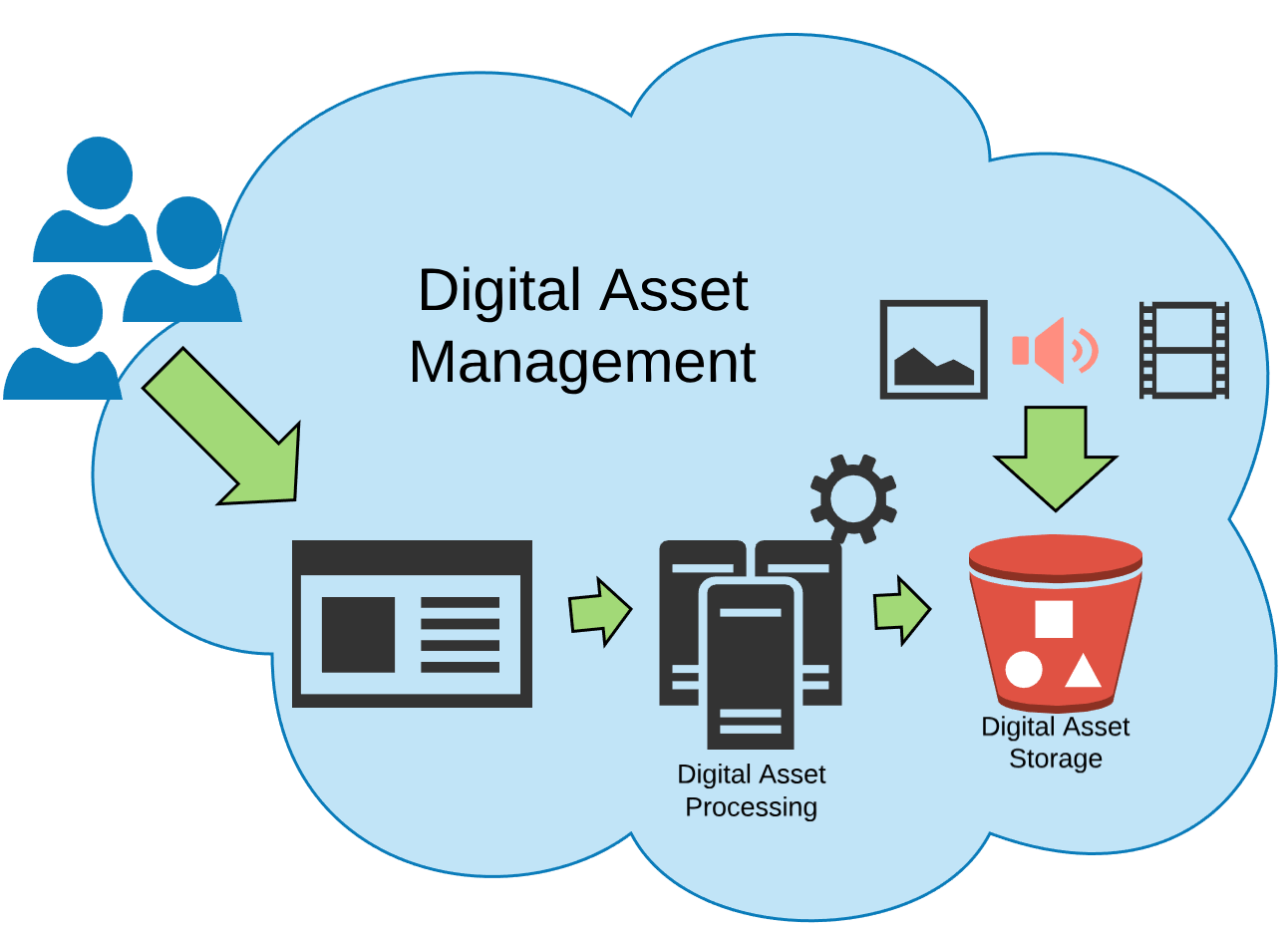
A typical digital asset management system built for companies is designed to let many people use shared files. A family has the opposite need: a small number of very private records that stay hidden until a specific moment. So when you look at any digital asset management platform for personal use, a few questions matter more than the feature list. Who can see my records while I’m alive? What exactly triggers access for someone else? What happens if I lose my own password? And does the service claim anything it can’t prove, such as being “completely unhackable”?
Be wary of promises that sound too tidy. No tool can guarantee that every account will be recoverable, and no tool replaces a Will.
Where EternaSafe Fits
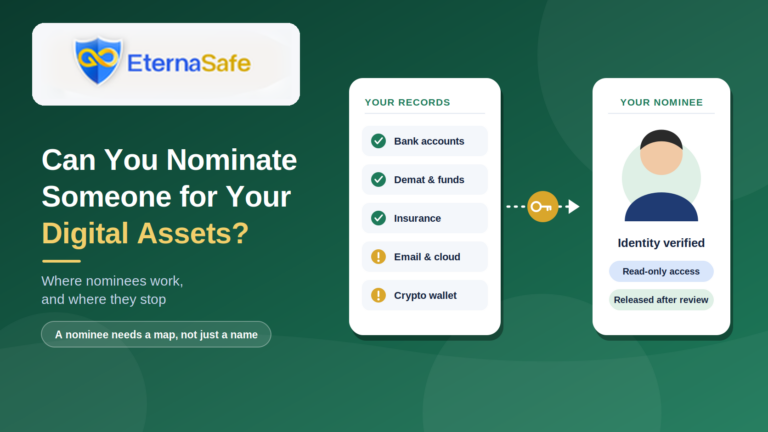
EternaSafe is built for exactly this gap. It’s a platform where you keep your family’s important information in one place, name the people you trust as nominees, and decide what each of them should be able to see.
While you’re alive, your nominees see nothing. Your information is encrypted, and if you stop responding for a period, the platform sends alerts to you first. Any login from you cancels the process. If it does go ahead, your nominees must verify their identity and the request is reviewed by people, so nothing is released automatically. That’s what we mean by Information Insurance for your loved ones: not an insurance policy, but a calm way of making sure your family doesn’t have to guess.
It isn’t a law firm, and it doesn’t replace a Will. Think of it as the missing piece beside one.
Start Small, And Start This Week
You don’t have to solve everything at once. Pick the three accounts your family would struggle with most, write them down, check the nominees, and tell one person where the list is. That alone moves you well ahead of most households.
The people you leave behind will have enough to deal with. Whether they can find your accounts shouldn’t be one of those things.