Key Takeaways:
- Physical vaults protect original documents but can delay family access when needed.
- Digital vaults provide convenient access to document scans, financial records and important instructions.
- Regular cloud storage may not offer the privacy and family access controls your documents require.
- EternaSafe uses zero-knowledge encryption and verified nominee access to protect sensitive family information.
- A hybrid storage plan combines physical originals with secure digital records and clear access instructions.
Quick Answer: The safest way to store important documents is to combine a physical vault with a secure digital vault. Keep original property papers, wills and certificates in a safe or bank locker, while storing encrypted scans, financial details and family instructions digitally for easier access when needed.
Think about the last time someone in your family needed an important document in a hurry, maybe it was the property papers for a loan, the insurance policy after a hospital admission or the passbook of an old bank account nobody had touched in years. More often than not, it is turning into a full house search, opening each and every almirah, going through files tied with string and finally calling a relative to ask “do you remember where Papa kept that?”. Now imagine the same situation when the person who knew where everything was is no longer there to answer, and this is exactly where most Indian families are finding themselves at the worst possible time.
So where should you actually keep your important documents, in a physical vault like a bank locker or home safe, or in a digital vault on your phone? Well, the honest answer is that both are doing a different job, and secure document storage is not just about keeping papers safe from fire or theft, it is also about making sure the right people can find them when it truly matters. Let’s break it down.
Why Secure Document Storage Is About More Than Just Safety
Most of us are thinking of secure document storage as keeping things locked away, but locking something away is only half of the problem, the other half is making sure your family knows it exists. When someone passes away unexpectedly, families are spending months tracking down bank accounts, insurance policies, investments, property documents and passwords, and many are never finding everything. As per figures shared by the Finance Minister in Parliament, around ₹1.84 lakh crore is lying unclaimed across India’s banks, insurers and mutual funds, and a large part of this is simply money that families did not know existed.
Poorly organised documents are usually resulting in:
- Months of running between banks, insurers and government offices.
- Assets and policies going unclaimed because nobody knew about them.
- Papers getting damaged by moisture, termites or a house shift.
- Passwords and online accounts becoming permanently inaccessible.
- Extra stress for a family that is already dealing with grief.
This is why the question is not just “where is it safe?” but also “who will be able to find it, and when?”, and keeping both of these in mind is making the choice between physical and digital vaults much clearer. If you have not yet listed out what your family actually needs, our guide on The Family Emergency Folder: 12 Documents Every Indian Household Needs is a good place to start.
Now, let’s take a look at how each type of vault is holding up.
Physical Vaults: The Traditional Way of Keeping Documents Safe
For generations, Indian families have been relying on the steel almirah, a locked drawer or the bank locker to keep their most valuable papers, and there is a good reason this habit is still continuing. Physical storage is keeping the original document, with its signatures, stamps and seals, and for many legal and official processes, the original is still what the bank, registrar or court is asking for.
The most common physical options include:
- Bank lockers or safe deposit boxes.
- Fireproof and waterproof home safes.
- Lockable cupboards or filing cabinets at home.
- A family file or diary with all the details written down.
Where Physical Vaults Are Doing Well
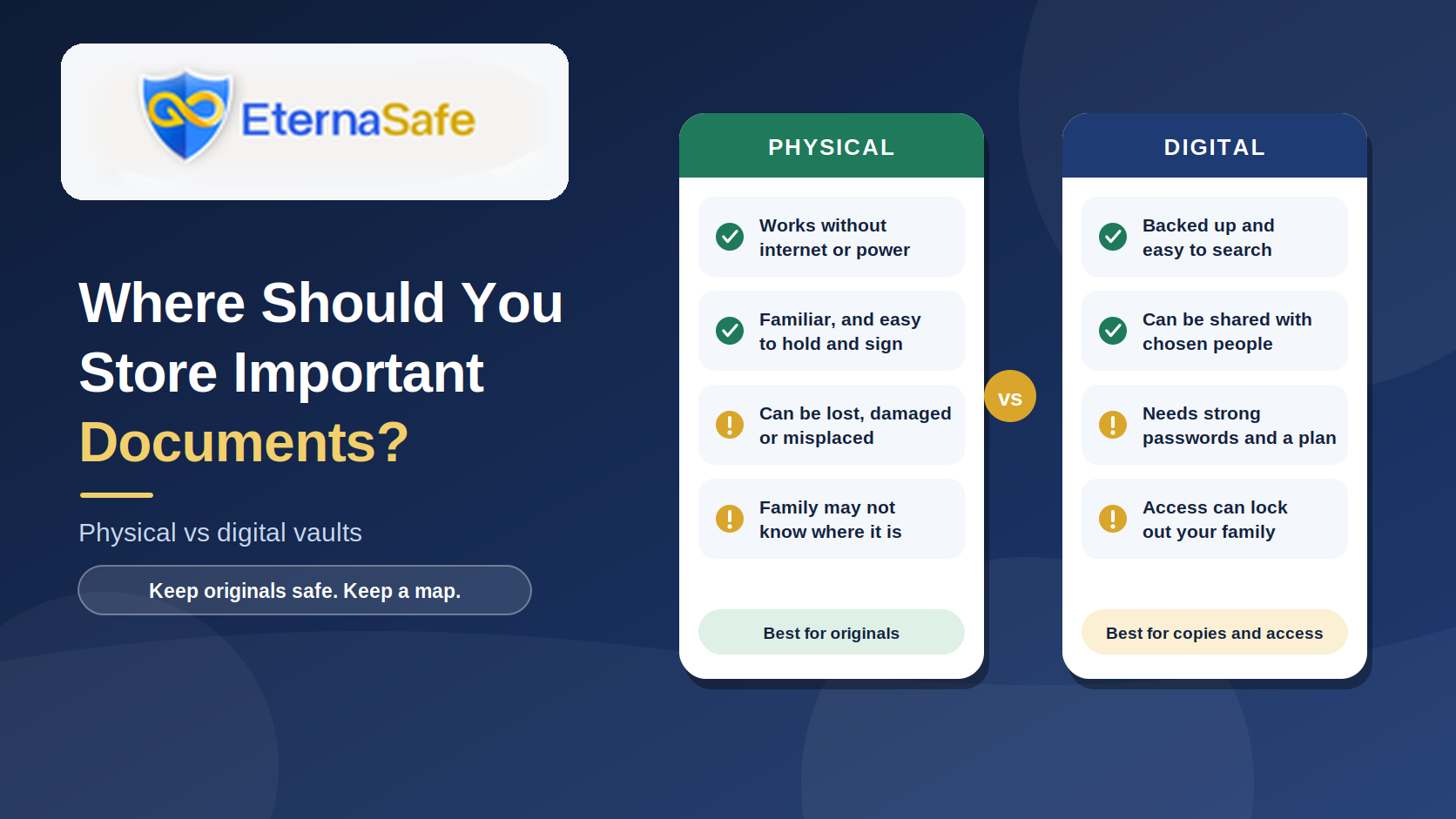
Original property deeds, sale agreements, a registered will, stamp papers, birth and marriage certificates and educational degrees are definitely best kept in their physical form in a secure place. A bank locker is adding restricted access and surveillance, while a good quality home safe is protecting papers from everyday risks, and neither of them is depending on the internet, passwords or apps to work.
Where Physical Vaults Are Falling Short
The limitations are becoming obvious the moment someone other than you needs access. A bank locker is only accessible during banking hours, and if the locker holder passes away, the family is going through a claim process with the bank before they can even open it, and that is assuming they know which bank and which branch the locker is in. A home safe can be stolen, damaged in a serious fire or flood, or simply forgotten in the back of a cupboard.
And that is not all, a physical diary with all your bank details and passwords is creating its own problem, because the moment your family knows something is written down, it is either causing worry while you are alive or getting misplaced when it is needed most. Paper is also slowly degrading with time, and humidity is doing its silent damage even inside a locked box.
Digital Vaults: Storage That Travels With You
A digital vault is a secure, encrypted space where you are storing scans, records, notes and details of your important documents, and with more official records now being issued digitally, digital vaults are quickly becoming an everyday part of secure document storage. They are making your information available anytime, from anywhere, and they are not getting affected by termites, leaking roofs or a misplaced key.
That being said, not every digital option is built for this job. Regular cloud drives, notes apps and WhatsApp chats with yourself are convenient, but the company running them can often access your files, and more importantly, there is no proper way for your family to get access if something happens to you. Sharing your password with someone today is solving the access problem but creating a privacy problem, and this is exactly the gap EternaSafe was built to close.
How EternaSafe Is Approaching Secure Document Storage Differently
EternaSafe is a zero-knowledge digital vault built specifically for Indian families, where you are storing your documents, financial records, passwords and personal messages, and they are released to your trusted nominees only when it truly matters. Instead of being just another place to dump files, it is organising your information in a way your family can actually use.
Your Data Is Encrypted Before It Even Leaves Your Phone
EternaSafe is using AES-256 client-side encryption, meaning your documents are encrypted on your own device with your private Unlock Password before they are ever uploaded. The servers are only storing encrypted, unreadable data, and your Unlock Password is never sent to or stored on EternaSafe’s servers, so even the EternaSafe team is not able to read what is inside your vault. Every login is also protected with OTP and two-factor authentication, your data is stored on AWS servers in India and never leaves Indian soil, and the platform is built to comply with the DPDPA 2023, India’s data protection law.
Everything Your Family Needs, Organised in One Place
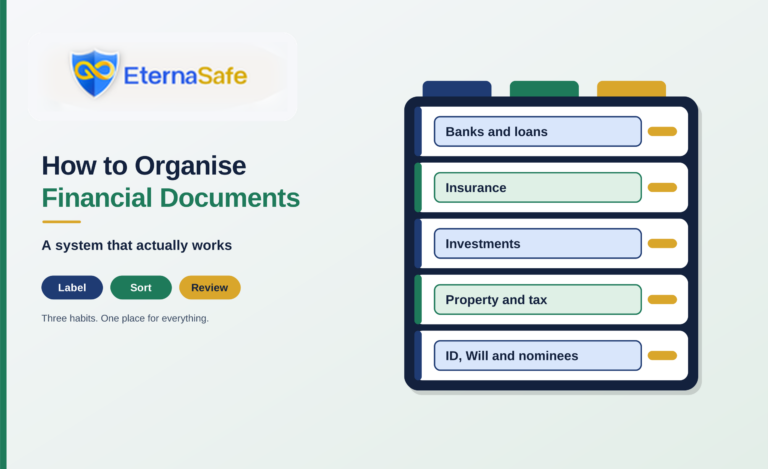
Rather than a folder full of random scans, EternaSafe is giving you five clear sections:
- Legacy Notes, for personal messages, passwords and document uploads.
- Assets Guide, with guided templates for bank accounts, insurance, investments, property and lockers.
- Business & Income Continuity Guide, for SOPs, vendor contacts and cashflow notes.
- Helpful Contacts, for your lawyer, CA, insurance agent, doctor and other trusted people.
- Nominees, where you can assign up to 3 trusted family members.
This structure is really helpful because your family is not just getting a pile of documents, they are getting a clear picture of what you have, where it is and how to claim it.
Access Only When It Is Truly Needed
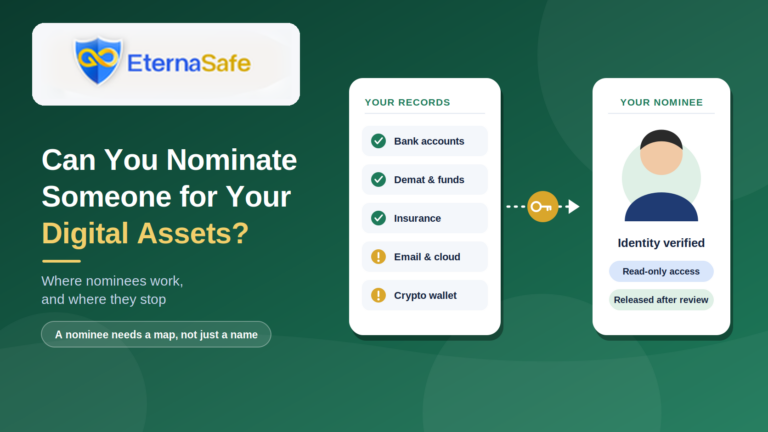
Your nominees are receiving a simple confirmation when you add them, but no access to your vault while you are around. EternaSafe’s smart inactivity system is quietly checking in the background, and if it notices you may not be reachable, it is sending you multiple alerts first, through SMS on the free plan and SMS, email and WhatsApp on paid plans. Only when all those attempts go unanswered and the nominee’s identity is verified, with admin oversight, does a nominee receive read-only access, and any login from you at any point is cancelling the process immediately.
To understand why this matters so much, our post on What Happens to Your Digital Assets After Death in India is explaining the problem in detail.
Physical vs Digital Vaults: A Quick Comparison
Here is a simple side-by-side look at how a traditional physical vault, a regular cloud drive and EternaSafe are comparing on the things that matter most.
| Feature | Physical Vault | Regular Cloud Storage | EternaSafe |
| Holds originals | Yes | No | No (stores details and scans) |
| Access anytime, anywhere | No | Yes | Yes |
| Provider can read your files | Not applicable | Often yes | No, zero-knowledge |
| Safe from fire, flood, pests | Partly | Yes | Yes |
| Family access after you | Slow, needs claims | Only if password shared | Verified nominee access |
| Organised for claims | No | No | Yes, guided templates |
| Data stored in India | Yes | Varies | Yes |
As you can see, each option is doing something well, but none of them is covering everything alone, which brings us to the smartest approach.
The Best Answer: Use Both, the Right Way
The most reliable secure document storage plan is a hybrid one, where originals are staying in a physical vault and everything your family needs to find and use them is sitting in a secure digital vault. A simple setup is looking something like this:
- Keep originals of property papers, your registered will and key certificates in a bank locker or fireproof safe.
- Use EternaSafe’s Locker template to record which bank, which branch and what is stored inside it.
- Upload scans of policies, ID proofs and certificates to your Legacy Notes.
- Fill the Assets Guide for each bank account, insurance policy and investment you hold.
- Add your nominees and your trusted contacts like your CA or lawyer.
There is one more extremely crucial step. When you sign up, EternaSafe is giving you a one-time Recovery Key, and because of the zero-knowledge design, if you lose both your Unlock Password and this Recovery Key, your vault cannot be recovered by anyone. The app itself is recommending that you write both down on paper and keep them in separate, physically secure places, which is a perfect example of physical and digital storage working together, the locker is protecting the key and the vault is protecting everything else.
Remember, a physical will is still covering the legal transfer of your assets, but it is not covering passwords, business contacts or the small details your family needs on day one. If you are still deciding how to go about it, read our guide on Digital Will vs Traditional Will: What Indian Families Should Know.
So, Where Should You Store Your Important Documents?
Well, the originals belong in a safe physical place, and everything else, the details, the scans, the passwords and the instructions your family will need, belongs in a secure digital vault that only they can open, and only when the time comes. Relying on just a locker is leaving your family searching for keys and branch names, while relying on just a phone folder is leaving your privacy and their access to chance, and putting the two together is closing both gaps in the simplest way possible.
Getting started with EternaSafe is taking less than 10 minutes, it is free to join and you do not need to fill everything in one go, you can start with a single note today and keep building it at your own pace. Your family is going to have enough to deal with on a difficult day, so making sure they are not also searching through drawers and bank branches is one of the kindest things you can do for them, and secure document storage done the right way is really just that, peace of mind for you today and clarity for them tomorrow. Download EternaSafe and start protecting what matters most.
FAQs
Is it safe to store important documents in a digital vault?
Yes, as long as you are choosing a vault that is built for sensitive information and not just a regular cloud drive or a chat app. EternaSafe is using AES-256 zero-knowledge encryption, which means your documents are encrypted on your own phone with your private Unlock Password before they are ever uploaded, and even the EternaSafe team is not able to read them. Along with OTP and two-factor authentication on every login and data stored only on servers in India, this is making it one of the safest options for secure document storage for Indian families.
Can a digital vault replace my original documents completely?
Well, not completely, and it is really important to understand this. Banks, registrars and courts are still asking for original documents in many cases, like property deeds, a registered will or certain certificates, so the originals should definitely stay in a bank locker or a fireproof safe. A digital vault like EternaSafe is doing the other half of the job, keeping scans, account details, passwords and instructions organised, so your family knows exactly what exists, where the originals are kept and how to claim them.
What happens if I forget my EternaSafe password?
Because EternaSafe is following a zero-knowledge design, your Unlock Password is never stored on its servers, so the team cannot reset it or recover your data for you. This is why you are getting a one-time Recovery Key when you sign up, and this key is the only backup to your vault. If both the Unlock Password and the Recovery Key are lost, the contents cannot be recovered by anyone, so it is extremely crucial to write both down on paper and keep them in separate, physically secure places, like your home safe and your bank locker.
How will my family get access to my documents if something happens to me?
You can assign up to 3 trusted nominees in the app, and they are only receiving a simple confirmation at first, with no access to your vault while you are around. If EternaSafe’s inactivity system notices you may not be reachable, it is first sending you multiple alerts, and only when all of them go unanswered and the nominee’s identity is verified with admin oversight, does the nominee receive read-only access. And that is not all, if you log in at any point during this process, it is getting cancelled immediately, so your privacy is staying fully in your hands until it is truly needed.