Key Takeaways:
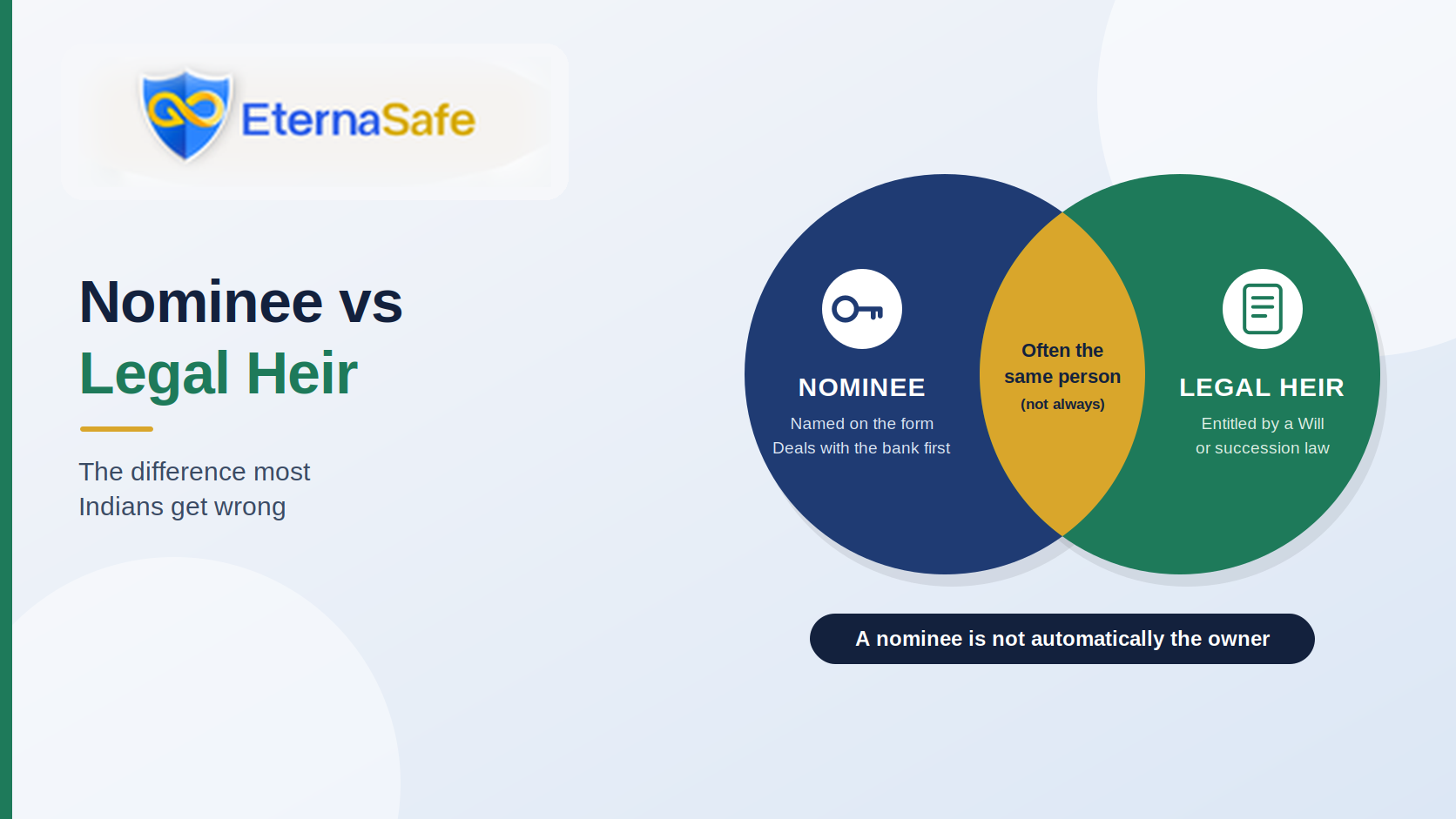
- A nominee receives an asset from the institution, while a legal heir is entitled to inherit it.
- For bank deposits, shares and mutual funds, nomination generally does not override inheritance rights.
- Life insurance has special rules for beneficial nominees who are parents, spouses or children.
- A valid will and updated nominations can help reduce inheritance disputes.
- Keeping asset records and nominee details organised helps families manage claims more easily.
Quick Answer: In India, a nominee is generally the person authorised to receive an asset from a bank or financial institution after the owner’s death, while a legal heir inherits it under a valid will or applicable succession law. The distinction varies by asset type, particularly for life insurance, making updated nominations and clear estate planning essential.
Picture this, a man opens a savings account years ago, and while filling the form at the bank counter, the staff asks him to add a nominee, so he quickly writes his younger brother’s name because he was not married at that time and never really thinks about it again. Years later, he is married with a child, life moves on, and when he passes away unexpectedly, the bank pays the entire balance to his brother, while his wife and son are left wondering how this even happened. Situations like these are playing out in Indian families every day, and almost all of them are starting with the same belief, that the nominee is the person who gets to keep the money.
But is that actually true? Well, not really, and this is exactly where the confusion around nominee vs legal heir is beginning. A nominee and a legal heir are two very different roles in Indian law, and understanding the difference is extremely crucial if you want your money to reach the right people without fights, court cases or years of paperwork. So let’s break it down.
Who Is a Nominee?
A nominee is the person you are naming on your bank account, fixed deposit, locker, insurance policy, shares, mutual funds or EPF account, so that the institution knows whom to pay or hand over the asset to after your death. In simple words, the nominee is making it easy for the bank or insurer to close the account and settle the claim quickly, without asking the family for a pile of legal documents.
In most cases though, the nominee is acting more like a trustee or caretaker of the money, and not its final owner. For example, when a commercial bank is paying a nominee, it is informing the nominee in writing that the money is being received as a trustee of the legal heirs. The bank is getting discharged from its responsibility the moment it pays the nominee, but the rights of the legal heirs are not ending there.
Who Is a Legal Heir?
A legal heir is the person who is actually entitled to inherit your assets by law. If you have made a valid will, the will is deciding who gets what, and if there is no will, the succession law that applies to you, based on your religion, is deciding who your legal heirs are, which usually includes your spouse, children and parents, and sometimes other relatives.
This means a legal heir is not someone you are choosing on a bank form, they are someone the law is recognising as the rightful owner of what you leave behind. And in many families, the nominee and the legal heir are actually the same person, which is why most people are never noticing the difference until a dispute comes up.
Now that both roles are clear, let’s take a look at how they compare side by side.
Nominee vs Legal Heir: The Key Differences
Here is a simple comparison to understand where the nominee’s role is ending and the legal heir’s right is beginning.
| Feature | Nominee | Legal Heir |
| Who decides | You, on the account or policy form | The will or succession law |
| Main role | Receives the asset from the institution | Inherits and owns the asset |
| Ownership | Usually holds it in trust for heirs | Final owner |
| Can be challenged | Yes, by the legal heirs | Can claim from the nominee |
| Can be changed | Anytime by the account holder | Only through a will |
| Paperwork for claim | Simple, usually death certificate and ID | Can need legal heir or succession certificate |
As you can see, the nominee is making the process faster, but the legal heir is the one with the actual right to the money, and this is the part most Indians are getting wrong.
What the Supreme Court Has Said
For years, there was confusion, especially around shares, because some people were arguing that a share nominee becomes the absolute owner. This was finally settled on 14 December 2023, when the Supreme Court in Shakti Yezdani v. Jayanand Jayant Salgaonkar held that a nominee of shares or securities is not getting beneficial ownership over them, and the legal heirs are not being excluded just because someone else was named as nominee. The Court also upheld that if shares are given to someone in a will, the will is taking priority over the nomination.
This was not a new idea either, as back in 1984, in Sarbati Devi v. Usha Devi, the Supreme Court had already held that an insurance nominee does not override the rights of legal heirs and is only receiving the money to distribute it as per succession law. Since then, the insurance law has changed a little, which we will come to in a moment.
How It Works for Different Assets
The tricky part is that the rules are not exactly the same for each and every asset, and knowing these small differences is saving families from a lot of stress later.
Bank Accounts, FDs and Lockers
The bank is paying the nominee, and the nominee is holding the money as a trustee of the legal heirs. And that is not all, from 1 November 2025, under the Banking Laws (Amendment) Act, 2025, bank customers are now able to add up to four nominees for their deposits, lockers and safe custody articles. For deposit accounts, you can either choose simultaneous nomination, where you are specifying each nominee’s share so that it totals 100%, or successive nomination, where the claim is passed to the next person in the order you set. For lockers, only successive nominations are allowed.
Shares, Demat and Mutual Funds
Shares and mutual fund units are being transmitted to the nominee, but after the Supreme Court ruling, the nominee is holding them for the legal heirs. SEBI’s new transmission framework, which came into force from 22 August 2026, is also clearly stating that nominees are receiving securities and mutual fund units as trustees on behalf of the legal heirs.
Life Insurance
Life insurance is the one place where things are a little different. After the 2015 amendment to Section 39 of the Insurance Act, if your nominee is your parent, spouse or child, they are considered a “beneficial nominee” and are entitled to the money. But even here, High Courts are not fully agreeing, as the Karnataka High Court has held that succession law still applies and divided the claim equally among the mother, wife and son, while the Andhra Pradesh and Rajasthan High Courts have taken the view that the beneficial nominee is receiving the money absolutely. So if your nominee is someone outside this close family group, like a brother or a friend, they are getting paid, but not as the final owner.
EPF and PPF
For EPF, if you have a family, you are required to nominate members of your family, and the provident fund is being paid to the nominee. For PPF and post office savings schemes, since 1 April 2018, you are actually able to specify on the nomination form whether each nominee is taking the money as owner or as trustee, which is a really useful option that very few people are aware of.
The Common Mistakes Indians Are Making
Most nominee vs legal heir disputes are not happening because of bad intentions, they are happening because of small mistakes made years ago that nobody went back to fix. The most common ones are resulting in:
- Nominees added before marriage and never updated after.
- No nominee at all on old accounts, FDs and share certificates.
- A will that says one thing and the nominations saying something completely different.
- Simultaneous nominations without clear percentage shares.
- Family members not knowing which accounts exist or who is named where.
- Assuming the nominee will “do the right thing” without any written record.
When any of these happen, the legal heirs are having to approach the nominee, and if the nominee is not cooperating, the only option left is a civil court, which means years of time, legal costs and broken relationships. If you have already faced a situation where an account had no nominee, our guide on What Happens to Your Bank Account After Deat is explaining what the family needs to do next.
So how do you make sure your family never ends up in such a situation? Let’s take a look.
How to Avoid Nominee vs Legal Heir Disputes
The good news is that most of these problems are completely preventable, and you do not need a lawyer for each and every step, you just need to be a little organised. A few simple steps are going a long way:
- Make a will and keep your nominations matching the people named in it.
- Use the new option of up to four nominees on bank accounts and specify clear shares.
- Review all your nominations after marriage, divorce, the birth of a child or a nominee’s death.
- Choose “owner” or “trustee” clearly on PPF and small savings nomination forms.
- Make sure your family knows what assets you have, who the nominees are and where the will is kept.
This is why the last step is becoming the most important one, because even the best planned nominations and will are not helping if your family does not know they exist. If you are still planning to make a will, our guides on Digital Will vs Traditional Will and How to Make an Online Will in India are a good place to start.
Where EternaSafe Fits In
Nominations and a will are taking care of the legal side, but your family is still needing a clear picture of everything, which bank, which policy, which demat account, who is the nominee on each one and where the will is kept. This is exactly what EternaSafe is helping you with.
EternaSafe is a zero-knowledge digital account built for Indian families, where you are recording your bank accounts, insurance policies, investments, property and locker details through guided templates in the Assets Guide, along with notes on who the nominee is for each one. You can also upload important documents, store passwords and leave personal messages or instructions in Legacy Notes, so your family is not guessing what you wanted.
One thing to note here, the nominees you are adding in EternaSafe are different from the nominees on your bank account or insurance policy. EternaSafe nominees are not inheriting any money, they are only receiving read-only access to the information you have stored, and only after you become unreachable and their identity is verified. Your data is encrypted on your phone before it is uploaded, so even the EternaSafe team is not able to read it, and it is staying on servers in India. This way, your nominations are deciding who receives the money, your will is deciding who keeps it, and EternaSafe is making sure your family actually knows about all of it.
Final Thoughts
The difference between a nominee and a legal heir is small on paper, but it is making a huge difference in real life, especially for families who are already going through a difficult time. A nominee is making the claim process easier, but in most cases, the legal heir is the one with the actual right to the money, and when the two are not aligned, it usually ends in confusion, disputes and long legal battles that nobody wanted.
The best thing you can do is keep your will and nominations aligned, update them whenever life is changing, and make sure your family knows exactly where everything is. EternaSafe is taking less than 10 minutes to set up and is free to join, so you can start today with just one account and keep adding at your own pace, and give your family the clarity they are going to need when it matters most.
FAQs
Is a nominee the same as a legal heir?
No, and this is the most common confusion. A nominee is the person you are naming on an account or policy to receive the money from the institution, while a legal heir is the person entitled to inherit it under your will or succession law. In many families, both are the same person, but when they are different, the nominee is usually holding the money as a trustee for the legal heirs.
Who has more right, the nominee or the legal heir?
Well, in most cases, the legal heir has the stronger right. For bank deposits, shares and mutual funds, the nominee is receiving the asset but holding it for the legal heirs, as the Supreme Court has clearly held in the Shakti Yezdani case. Life insurance is the main exception, where a parent, spouse or child named as nominee is treated as a beneficial nominee, although High Courts have taken different views when other heirs are claiming.
Can legal heirs claim money from a nominee?
Yes, legal heirs are definitely able to claim their share from the nominee, either by mutual agreement through a family settlement or by approaching a civil court if the nominee is not cooperating. They can also approach the court before the bank pays out, in which case the bank is not paying the nominee once it knows of a court order stopping the payment.
Does a will override the nomination?
For assets like shares, a will is taking priority over the nomination, and the Supreme Court has upheld this. For bank accounts, the bank is still paying the nominee as per its records, but the beneficiaries named in your will are able to claim the money from the nominee afterwards. This is why keeping your will and nominations aligned is extremely crucial, as it is avoiding disputes from the very start.
How many nominees can I add to my bank account now?
From 1 November 2025, you are able to add up to four nominees for your bank deposits, lockers and safe custody articles. For deposits, you can choose simultaneous nomination with clear percentage shares totalling 100%, or successive nomination where nominees are getting the claim in a set order, while for lockers, only successive nomination is allowed.