Key Takeaways:
- Nearly ₹2.2 lakh crore in financial assets was reportedly unclaimed across India as of December 2025.
- Unclaimed assets include bank deposits, shares, dividends, insurance proceeds, EPF balances and mutual funds.
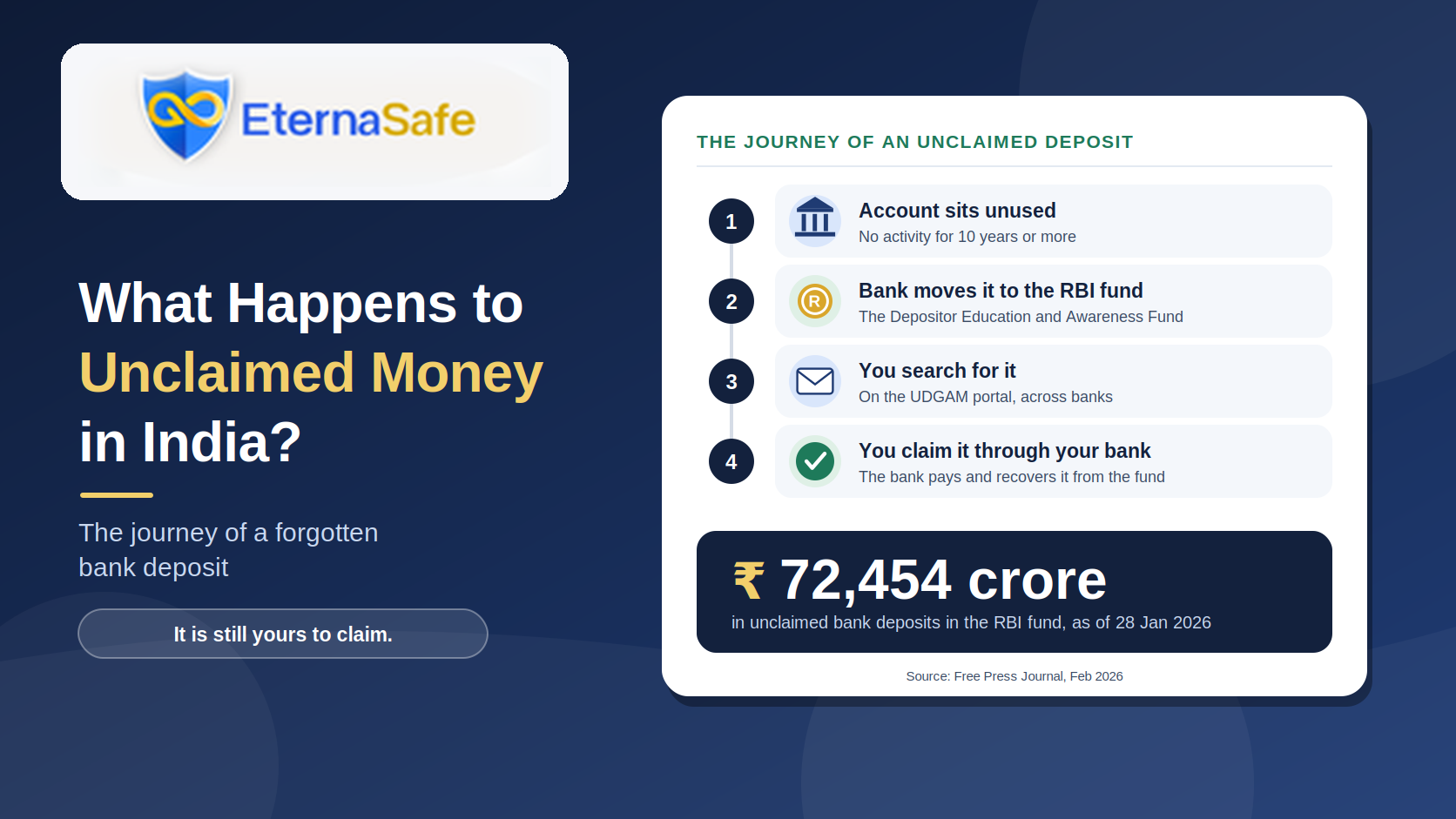
- Bank deposits move to the RBI’s DEA Fund after 10 years of inactivity.
- UDGAM, IEPFA, Bima Bharosa, MITRA and EPFO help families trace different types of unclaimed assets.
- Updated nominations, organised financial records and clear family instructions can help prevent assets from going unclaimed.
Quick Answer: Unclaimed money in India includes forgotten bank deposits, insurance proceeds, shares, dividends, mutual funds and EPF balances. Families can trace these assets through portals such as UDGAM, IEPFA, Bima Bharosa, MITRA and EPFO, then claim them through the relevant institution with the required documents. Legal heirs can also claim eligible assets after the owner’s death.
Remember how every family has that one old steel trunk or almirah drawer which nobody really opens, filled with yellowed passbooks, an LIC policy bond from the 90s, some share certificates of a company nobody has heard of in years and a few letters from a bank branch that does not even exist anymore? Most of us are looking at these papers, thinking they are just old memories, and putting them back in the trunk, without realising that some of them might still be holding real money that is sitting quietly somewhere in the financial system, waiting for someone to claim it.
And this is not happening in a few homes, it is happening across the country at a scale that is hard to believe. As per a report by 1 Finance Magazine, nearly ₹2.2 lakh crore worth of financial assets were lying unclaimed across banks, insurers, mutual funds, EPF and the stock market as of December 2025. But what actually happens to all this money, who is holding it and can your family still get it back? Well, let’s break it down.
What Is Unclaimed Money in India?
Unclaimed money is basically any money that belongs to someone, but has not been touched, claimed or collected for a long time, either because the owner forgot about it, could not be contacted or passed away without their family knowing it existed. This includes savings and current accounts that have been inactive for years, fixed deposits that matured and were never collected, insurance policies where the maturity or death claim was never filed, dividends that were never encashed, shares, mutual fund units and old EPF balances.
The important thing to understand is that this money is not lost and it is not taken by the government, it is still belonging to the original owner or their legal heirs. It is just being moved from one place to another over the years, and the longer it stays unclaimed, the further it is moving away from the family that it belongs to.
So where exactly is all this money sitting? Let’s take a look.
Where Is the ₹2 Lakh Crore Actually Sitting?
The biggest challenge with unclaimed money India is facing is that it is not sitting in one place, it is spread across multiple regulators and institutions, each with its own rules, portals and processes. Here is a simple breakdown of where the money is lying, as per the 1 Finance report.
| Asset Type | Unclaimed Amount | Who Is Holding It |
| Bank Deposits | ₹97,545 crore | RBI’s DEA Fund |
| Shares and Dividends | ₹89,004 crore | IEPFA |
| Insurance Policies | ₹20,062 crore | Insurers / SCWF |
| EPF Accounts | ₹10,915 crore | EPFO |
| Mutual Funds | ₹3,452 crore | AMCs and RTAs |
| REITs, InvITs, NCDs | ₹764 crore | Issuers / Exchanges |
As you can see, bank deposits and shares together are making up the large majority of this money, and a lot of it is coming from the pre-digital days of paper share certificates, physical passbooks and dividend warrants sent by post, when there was no easy way to keep track of everything in one place.
You will also find some reports quoting a smaller figure of around ₹1 lakh crore, and that is because they are not counting the market value of shares held with IEPFA, but either way, the size of the problem is really not small.
What Happens to Unclaimed Money Over Time?
Each type of asset is following its own timeline before it is being officially marked as unclaimed and transferred, and knowing these timelines is extremely crucial for any family trying to trace old money.
Bank Accounts and Fixed Deposits
A bank account that has not been operated for two years is classified as dormant, and if it stays untouched for 10 years, the balance is transferred to the RBI’s Depositor Education and Awareness (DEA) Fund. The same is applying to fixed deposits that matured and were never renewed or collected. The good part is that depositors or their legal heirs can still claim this money at any time, but while it is sitting there, it is only earning around 3% simple interest, which is much lower than inflation, so the real value of the money is slowly reducing each and every year.
Shares and Dividends
If dividends on shares remain unpaid or unclaimed for seven years, the dividend and the shares themselves are being transferred to the Investor Education and Protection Fund Authority (IEPFA). Once the shares move there, they are not losing their ownership, but the family is now having to go through a separate claim process with IEPFA to get them back.
Insurance Policies
Insurance money is turning unclaimed when maturity proceeds or claims are not collected within 12 months of becoming due. After a certain period, these amounts are transferred to the Senior Citizens’ Welfare Fund, but policyholders or their legal heirs are still able to claim them for up to 25 years after the transfer.
EPF and Mutual Funds
EPF accounts are becoming inactive after three years without contributions, which is very common when people are switching jobs and forgetting to transfer their old PF balance. Mutual fund money, on the other hand, is going unclaimed when the fund house is unable to pay out redemption or dividend amounts because of outdated bank details or contact information.
This is why so many families are not even realising there is money to claim, because by the time they start looking, it has already moved from the bank or insurer to a completely different authority.
Why Does So Much Money Go Unclaimed in India?
The reasons are not hard to see, and most of them are not about carelessness, they are about missing information. Money is usually going unclaimed in India because of:
- Outdated KYC, phone numbers and addresses, so institutions cannot reach the owner.
- Missing or outdated nominations on bank accounts, policies and investments.
- Deaths not being reported to banks and insurers in time.
- Family members not knowing which accounts, policies or investments even existed.
- Old physical records like passbooks and share certificates getting lost or damaged.
- Small amounts being forgotten after switching jobs, cities or banks.
Out of all these, the biggest one is definitely the last missing link between the person and their family. In most Indian households, one person is usually managing all the finances, and when something happens to them, the rest of the family is left guessing, searching through drawers and calling relatives to ask “did Papa have an account in that bank?”. If you want to understand what this process looks like from a family’s point of view, our guide on What Happens to Your Bank Account After Death? A Family Guide is explaining it step by step.
What Is the Government Doing About It?
The government and regulators are now actively trying to return this money to its rightful owners, and a few steps are already making things easier. In October 2025, the Finance Minister launched the “Your Money, Your Right” campaign to help people settle unclaimed bank deposits, insurance, dividends, shares and mutual funds, and the three-month drive which ended in December 2025 helped return around ₹2,000 crore. This is a good start, but when you compare it to the total amount lying unclaimed, it is also showing how big the gap still is.
And that is not all, on 29 May 2026, the Department of Financial Services launched the Unclaimed Assets Portal (unclaimedassetsportal.in), a single gateway that connects people to all the separate portals for checking unclaimed money. The Banking Laws (Amendment) Act, 2025 is also now allowing multiple nominees on bank accounts, which is making the inheritance process smoother for families.
How to Check and Claim Unclaimed Money in India
If you think you or your family might have some money lying unclaimed, the process is fairly simple to start with, you just need to know where to look. The main portals you should be checking are:
- UDGAM portal by RBI, for unclaimed bank deposits across participating banks.
- IEPFA portal, for shares and dividends that were transferred after seven years.
- Bima Bharosa portal by IRDAI, for insurance policy proceeds.
- MITRA platform, for inactive and unclaimed mutual fund folios.
- EPFO portal, for old and inactive PF accounts.
Once you find something, the actual claim is still being filed with the respective bank, insurer, fund house or authority, along with documents like ID proof, the death certificate if the owner has passed away and succession papers or a legal heir certificate where needed. This step is often taking time and multiple visits, which is why many families are giving up halfway, even after they find the money.
The Real Solution: Making Sure Your Family Never Has to Search
Portals are definitely helping families find money that has already gone unclaimed, but the smarter approach is making sure your money never ends up there in the first place. And for that, you are not needing anything complicated, you just need your family to know what you have, where it is and how to claim it, at the right time.
This is exactly what EternaSafe was built for. It is a zero-knowledge digital account made for Indian families, where you are recording your bank accounts, insurance policies, investments, property and even bank locker details through simple guided templates in the Assets Guide, so nothing is left to guesswork. You can also store important documents, passwords and personal messages in Legacy Notes, and keep a list of helpful contacts like your CA, lawyer or insurance agent in one place.
Your information is encrypted on your own phone before it is uploaded, so even the EternaSafe team is not able to read it, and your data is staying on servers in India. You are assigning up to 3 trusted nominees, who are not getting any access while you are around, and only if you become unreachable and their identity is verified, are they receiving read-only access to everything you left for them. This way, your family is not just finding out that something exists, they are getting a clear guide on how to claim it, from beginning until completion.
Along with this, a few simple habits are going a long way:
- Add or update nominees on each and every bank account, policy and investment.
- Keep your KYC, phone number and address updated everywhere.
- Close or consolidate accounts you are no longer using.
- Transfer old EPF balances whenever you are switching jobs.
- Review your list of assets at least once a year.
If you are not sure how nominations are working for different assets, read our guide on Can You Nominate Someone for Your Digital Assets?
Final Thoughts
The ₹2 lakh crore problem is not really a money problem, it is an information problem, because almost all of this money belongs to real families who simply did not know it existed or did not know how to claim it. Government portals and campaigns are definitely making it easier to find what has already gone unclaimed, but the best way to protect your family is making sure they are never put in that position at all.
It is taking less than 10 minutes to get started with EternaSafe, and you do not need to fill in everything in one go, you can start with just one bank account or one policy today and keep adding at your own pace. Your hard-earned money should be reaching the people you love, not sitting in a fund somewhere earning 3% interest, so take that first step today and make sure your family always knows exactly where to look.
FAQs
How do I check if I have unclaimed money in India?
The easiest way to start is the Unclaimed Assets Portal (unclaimedassetsportal.in), which the Department of Financial Services launched in May 2026 as a single gateway for checking unclaimed money in India. From there, you are getting redirected to the right portal for each asset type, like UDGAM for bank deposits, Bima Bharosa for insurance, MITRA for mutual funds and the IEPFA portal for shares and dividends, and for old PF balances, you can check directly on the EPFO portal. Just keep your PAN, Aadhaar and old account or policy details handy, as this is making the search much faster and more accurate.
Is unclaimed money lost forever or taken by the government?
Well, no, and this is one of the biggest misconceptions people are having. Even after bank deposits move to the RBI’s DEA Fund, shares go to IEPFA or insurance money is transferred to the Senior Citizens’ Welfare Fund, the money is still belonging to the original owner or their legal heirs. Bank deposits can be claimed back at any time, and insurance amounts can be claimed for up to 25 years after the transfer, but the longer the money is sitting there, the more value it is losing, as the DEA Fund is only paying around 3% simple interest.
Can legal heirs claim unclaimed money after the account holder passes away?
Yes, legal heirs and nominees are definitely able to claim it, but they are having to approach the respective bank, insurer, fund house or authority directly with the right documents. This usually includes their own ID proof, the death certificate of the account holder and a legal heir certificate or succession papers where there is no nominee registered. The process is becoming much smoother when a valid nomination is already in place, which is why updating nominees on each and every account and policy is extremely crucial.
How can I make sure my family never ends up with unclaimed money?
The simplest way is making sure your family knows exactly what you have, where it is and how to claim it, without having to search through old drawers and passbooks. EternaSafe is helping you do this by recording your bank accounts, insurance policies, investments, property and locker details through guided templates, all encrypted on your own phone before they are uploaded. Your trusted nominees are not getting any access while you are around, and only when you are unreachable and their identity is verified, are they receiving read-only access to everything you left for them, so your hard-earned money is reaching your family and not sitting in a fund somewhere.