The last time you were filing your income tax return and an entire Sunday went into searching for Form 16, last year’s ITR acknowledgement, an LIC premium receipt and that one rent agreement which was supposedly kept “safely” somewhere in the house? Some papers were in a plastic folder inside the cupboard, some were sitting in your email, a few were saved as WhatsApp photos, and the rest were simply nowhere to be found.
This is the reality in most Indian households, and it is not happening because people are careless, it is happening because nobody is ever really teaching us how to organize financial documents in a way that lasts. But is there actually a system that is working for busy professionals and families without needing hours every single week? Well, there definitely is, so let’s break it down.
Why Most People Struggle to Organize Financial Documents
For many years, families have been relying on one person, usually the father or the eldest member, to keep track of each and every paper, and this approach is resulting in:
- Documents scattered across cupboards, lockers, email and phone galleries.
- Last-minute panic during tax filing, loan applications or insurance claims.
- Missed renewals, lost receipts and duplicate payments.
- Family members having no idea where anything is kept.
Problems like these don’t just waste your time, they also become extremely serious when that one person is suddenly not available, which is exactly what our article on what unpreparedness actually costs a family is explaining. When you organize financial documents properly, you are not just making your own life easier, you are also protecting your family from months of confusion later, so let’s take a look at what you should be keeping.
What Financial Documents Should You Be Keeping?
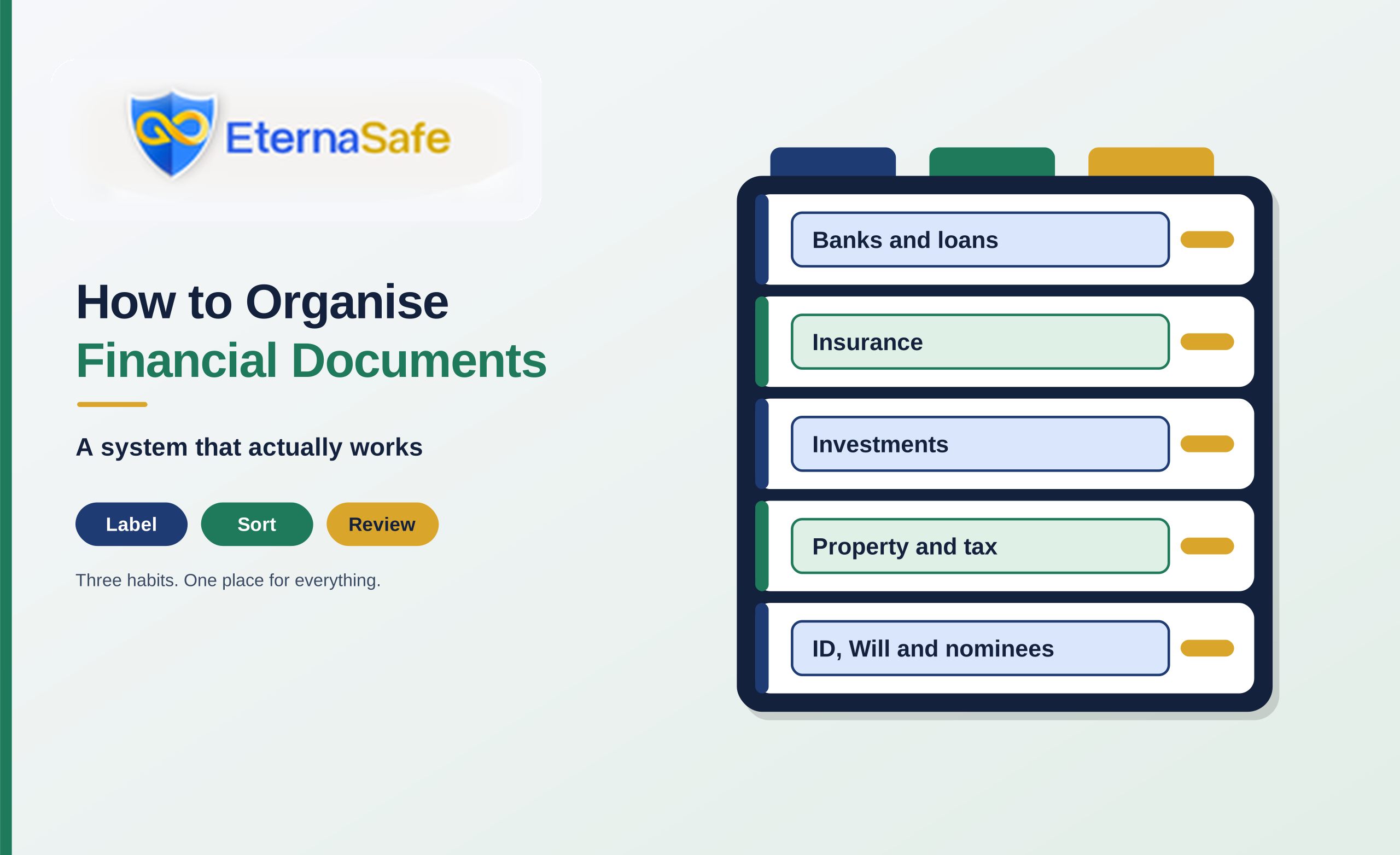
Most people are underestimating how many papers they are holding, and the first step to organize financial documents is knowing which categories are actually mattering:
| Category | Documents Included | Why It Matters |
| Identity and KYC | PAN, Aadhaar, Passport, Voter ID | Needed for Every Financial Process |
| Banking | Passbooks, Statements, FD Receipts, Locker Details | Proof of Funds and Account Access |
| Income and Tax | Form 16, ITR Acknowledgements, Form 26AS, Investment Proofs | Tax Filing and Loan Applications |
| Insurance | Term, Health, Vehicle and Life Policies | Smooth and Timely Claims |
| Investments | Mutual Fund, Demat, PPF, EPF and NPS Statements | Tracking and Transfer of Wealth |
| Property and Loans | Sale Deeds, Loan Agreements, NOCs, Tax Receipts | Proof of Ownership and Repayment |
| Legal | Will, Nomination Forms, Power of Attorney | Smooth Succession for Family |
You can also go through our list of 12 emergency documents every Indian household needs to make sure no important paper is being missed when you organize financial documents for the first time.
A Simple System to Organize Financial Documents That Actually Works
Once you know what you are holding, the actual system is not complicated at all, and if you are following these steps in order, the whole process is becoming hassle-free from beginning until completion.
Step 1: Gather Everything in One Place
Pull out each and every paper from cupboards, drawers, old bags and lockers, and also download the statements and policy copies sitting in your email and banking apps, because you cannot organize financial documents that you cannot even see. This first round is usually taking a full weekend, but it is really the only time you will need to put in this much effort.
Step 2: Sort Documents Into Clear Categories
Use the categories from the table above and create one physical folder and one digital folder for each, so that banking, tax, insurance and property papers are never getting mixed again. Within each category, arrange the documents by financial year or by account, which is making it much faster to find something when a bank, CA or insurer is asking for it.
Step 3: Decide What to Keep and What to Shred
Not every paper needs to stay with you forever, and keeping too much is just as confusing as keeping too little, so a simple rule is helping here:
- Keep Permanently: Property deeds, your will, loan closure NOCs and insurance policies.
- Keep for Six to Eight Years: ITR records, Form 16 and investment proofs.
- Keep Until Replaced: Bank statements, utility bills and premium receipts.
- Shred Safely: Expired cards, old cheque books and duplicate copies.
This is keeping your folders lean, and it is also reducing the risk of sensitive information being misused when old papers are thrown away without shredding.
Step 4: Go Digital With a Proper Naming System
Scan each important document and save it with a clear and consistent name like “2025-26_Form16_CompanyName” or “Bank_Savings_Statement_Mar2026”, so that searching takes seconds instead of minutes. Avoid keeping these files only on your phone or in WhatsApp chats, as phones are getting lost, changed or damaged far more often than people are expecting.
Step 5: Keep Originals Safe and Copies Accessible
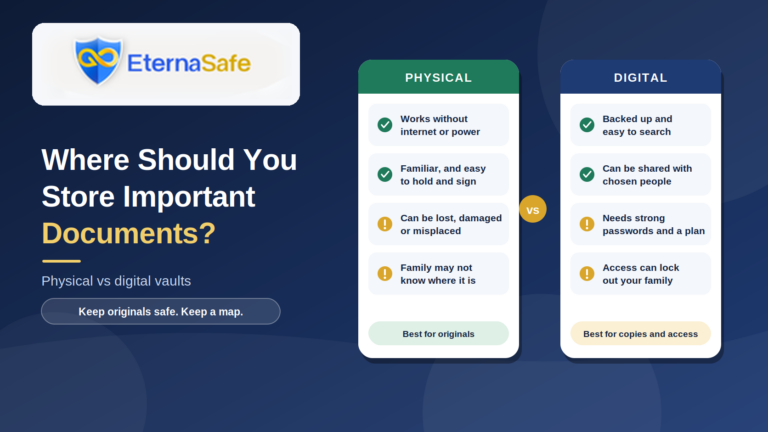
Originals like sale deeds and policy bonds are better kept in a fireproof box or a bank locker, while the digital copies should be stored somewhere secure that your family can reach when needed. Our comparison of physical vs digital vaults is explaining which option is suiting which type of document.
Step 6: Create a Master List for Your Family
This is the step most people are skipping, and it is really the most important one, because even a perfectly organised cupboard is useless if your family does not know what is inside it. Make one master list with account numbers, policy numbers, branch details, nominees and contact persons, so anyone at home can understand your finances within minutes.
Step 7: Set a Yearly Review Routine
Pick one fixed time every year, like right after filing your ITR, to update statements, remove outdated papers and add new policies or investments. Big life events like marriage, a new job, buying a home or becoming a new parent should also be triggering a quick review, because these are changing both your documents and your nominees.
Even with a good system in place, a few habits are quietly undoing all the hard work, so let’s take a look at them.
Common Mistakes to Avoid While Organising Documents
People who are trying to organize financial documents for the first time are often making these mistakes:
- Keeping only one copy, either physical or digital.
- Writing passwords on paper and keeping them next to the documents.
- Forgetting to tell anyone where the files are kept.
- Ignoring trading apps, crypto wallets and email accounts.
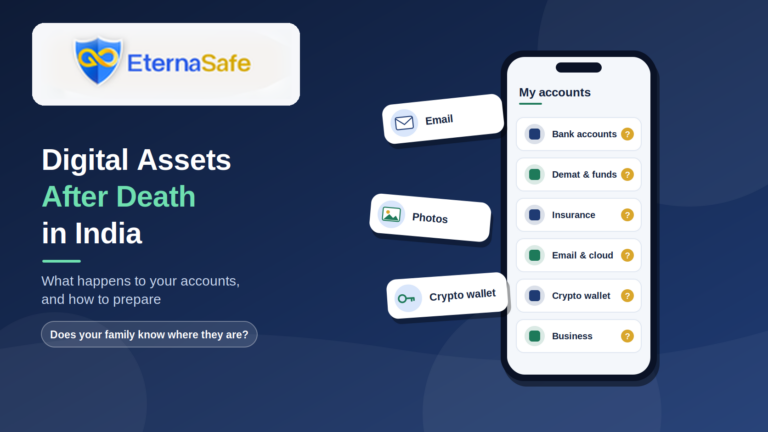
Digital accounts especially are needing attention, and our guide on digital assets after death in India is explaining why they are getting left behind so often.
How EternaSafe Is Helping Families Organize Financial Documents
A cupboard or a hard drive can store your papers, but it cannot tell your family what each account is for, how to claim it or whom they should be calling first, and this is exactly where most families are getting stuck. EternaSafe is a zero-knowledge digital account built for Indian families, with guided templates for bank accounts, insurance, investments, property and lockers, so you can organize financial documents field by field without missing anything.
And that is not all, everything is encrypted with AES-256 on your own device and stored on Indian servers, and it is released only to up to three verified nominees when it truly matters, so your information is staying private while you are alive and reachable for your family when they really need it.
Final Thoughts
Learning how to organize financial documents is not about becoming perfectly tidy overnight, it is about building a simple system that you can follow every year and that your family can understand without you having to explain it. Once your papers are sorted, labelled, stored safely and listed in one place, tax season, loan applications and insurance claims are becoming far less stressful, and your family is having the clarity that most Indian households are still missing.
So if your documents are still spread across cupboards, inboxes and WhatsApp chats, this weekend is definitely a good time to start, and setting up your EternaSafe account is making sure all that effort is reaching the people who matter the most.
FAQs
What is the best way to organize financial documents at home?
The best way to organize financial documents is sorting them into categories, keeping digital copies and maintaining one master list for your family.
Which financial documents should I keep permanently?
Property deeds, your will, loan closure NOCs and insurance policies should be kept permanently in a safe and accessible place.
How long should I keep income tax records in India?
It is safer to keep ITR records, Form 16 and investment proofs for at least six to eight years, as older assessments can be reopened.
Is it safe to store financial documents digitally?
Yes, as long as you are using an encrypted platform with strong passwords instead of phone galleries or chat apps.
How often should I organize financial documents?
You should organize financial documents at least once a year, and also after big life events like marriage, childbirth or buying a home.
Should my family know where my financial documents are kept?
Yes, your spouse or nominees should definitely know where your documents and master list are kept, so they are never searching during an emergency.