Quick Answer: Getting your parents ready for a financial emergency comes down to five things: a six-to-twelve-month emergency fund, documents kept in one place, current nominee details, health insurance matched to real hospital costs, and a will. Sorting out digital access, banking, email, investment logins helps families move faster when something goes wrong.
Most Indian families only think seriously about their parents’ financial vulnerability after something has already gone wrong: a hospital admission, a missed pension payment, a bank account nobody can access. By then, the options are narrower and the stress is higher than it needed to be. A parent’s financial life rarely fails all at once, it usually comes apart at the seams that nobody checked.
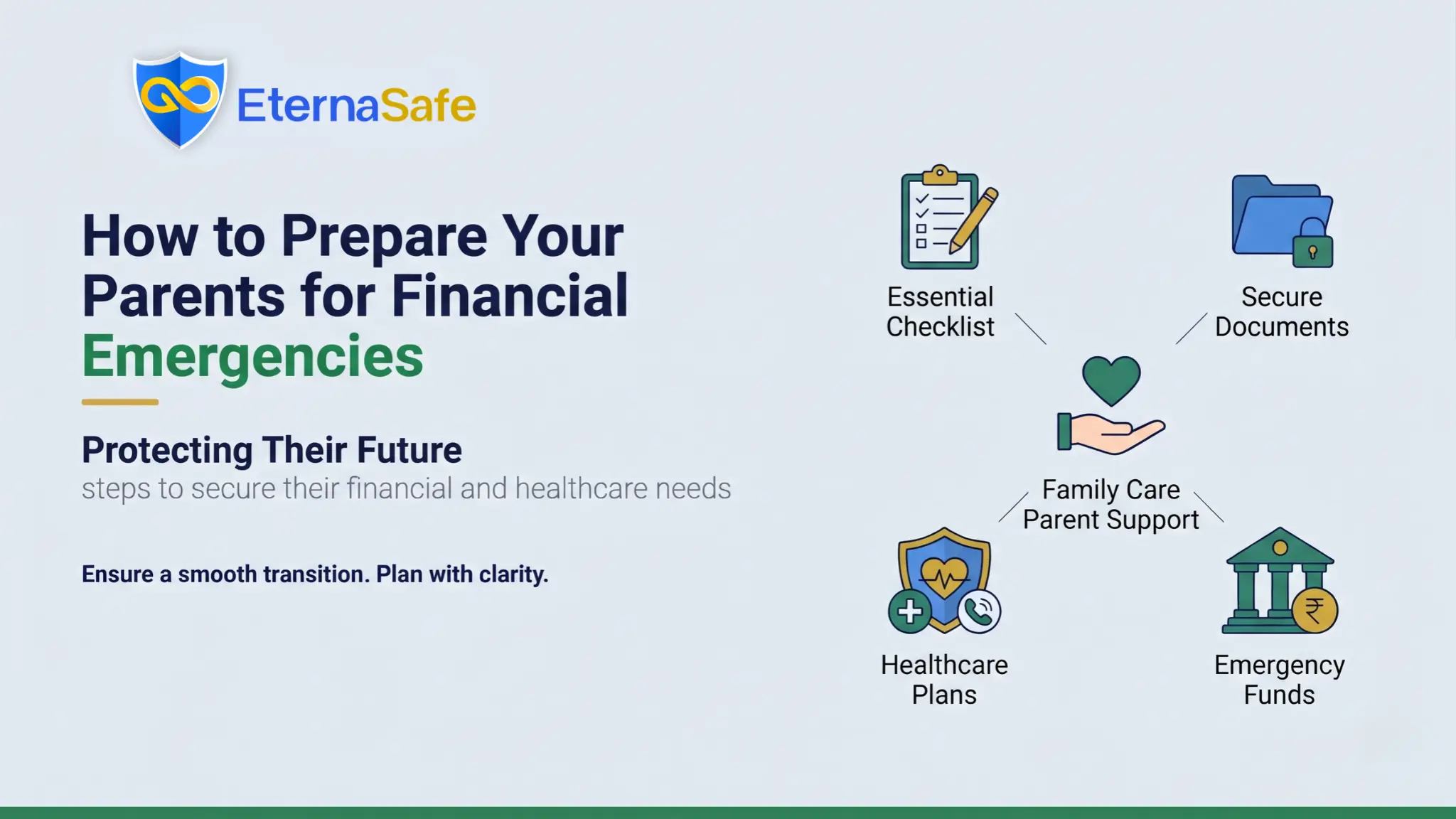
This piece walks through the practical steps that make up financial planning for parents: building an emergency fund, organising documents, fixing outdated nominations, getting the right insurance, writing a will, and accounting for digital accounts. Each step closes one specific gap that Indian households tend to leave open. Doing this work before a crisis, rather than during one, is what actually changes the outcome.
Why Financial Emergencies Catch Families Off Guard?
Healthcare costs have climbed faster than most household budgets, and parents are living longer with more chronic conditions than a generation ago. Add to that the usual Indian household pattern, a savings account here, a fixed deposit there, an LIC policy nobody remembers the number of, and it becomes clear why families struggle when something urgent happens. The problem is rarely a lack of money; it is not knowing where the money is or how to reach it quickly.
There is also a quieter issue: parents often avoid discussing their finances with their children at all, out of habit or discomfort. That silence only gets more expensive over time. The fix isn’t a single conversation but a standing one, backed by documentation that doesn’t depend on memory, which is exactly where an emergency fund and a proper filing system come in.
Step 1: Build a Dedicated Emergency Fund for Elderly Parents
This fund needs to sit apart from parents’ regular savings, and it needs to be reachable without penalties or a multi-day withdrawal process. Six to twelve months of essential expenses, medical bills, household costs, regular medication, is the range most planners work with, and it’s a reasonable starting point for most families. Without this cushion, a sudden expense usually forces a loan or the early break of a long-term investment that was never meant to be touched.
The table below compares instruments by how usable they actually are in an emergency.
| Instrument | Liquidity | Suitability for Emergency Fund |
| Savings Bank Account | High | Good for money you may need within hours |
| Liquid Mutual Funds | High | Decent returns, still redeemable quickly |
| Fixed Deposits With Premature Withdrawal | Moderate | Works as a second layer, not the first |
| Senior Citizen Savings Scheme | Low | Lock-in period makes this unsuitable here |
| Equity Investments | Low | Too volatile to rely on in a crisis |
Revisit this fund once a year, and adjust it if medical needs change or inflation pushes up routine costs.
Step 2: Organise and Centralise Financial Documents
A large share of the delay in any family emergency comes down to one person knowing where things are kept, and that person being unreachable. Passbooks, insurance papers, property documents, and investment statements end up spread across almirahs and folders that only one parent fully understands. The moment that parent is hospitalised or otherwise unable to talk, the rest of the family is stuck.
A single, labelled system, physical or digital, solves this, and it doesn’t need to be complicated to work. This guide on organising financial documents walks through a method built to hold up even when everyone involved is stressed and short on time. Once documents are centralised, decisions that used to take days can often be made in hours.
Step 3: Review and Update Nominee Details Across Bank Accounts and Investments
Nominee entries are often the most neglected line item on any account, sometimes unchanged since the account was opened decades ago. A missing or outdated nominee can hold up a fund transfer for weeks, even when there’s no real dispute over who the money belongs to. It helps to understand the legal distinction here: a nominee usually receives the funds as a trustee, while the actual ownership passes to legal heirs under succession law or the terms of a will.
Go through savings accounts, fixed deposits, mutual funds, insurance policies, and EPF accounts, and check whether the nominee named still makes sense. This matters most after a marriage, the birth of a grandchild, or the death of whoever was named earlier. For a closer look at how banks and investment houses actually handle this process, bank accounts and investments after death covers the procedural detail families usually ask about.
Step 4: Secure Health Insurance and Medical Emergency Coverage
Hospitalisation is still the single biggest threat to a retired household’s savings, which makes health insurance for parents less of a nice-to-have and more of a load-bearing decision. Families routinely underestimate what a serious illness actually costs until a bill arrives, by which point the coverage gap is no longer theoretical. One practical upside: premiums paid for senior citizen health cover also qualify for deduction under Section 80D of the Income Tax Act.
Before buying or renewing a policy, check these points against what’s actually realistic for your parents’ city and health history:
- The coverage amount against real hospitalisation costs in your area, not a generic industry average.
- Waiting periods on pre-existing conditions, which tend to be longer for older applicants.
- Whether the network hospitals offer cashless treatment near where your parents actually live.
- Co-payment clauses, which many senior citizen policies quietly build in.
- Age limits on renewal, so coverage doesn’t lapse right when it’s needed most.
Going through this list properly before signing anything is usually what separates a policy that helps from one that disappoints when it’s tested.
Step 5: Create a Will and Begin Estate Planning Early
A clearly written, legally valid will does more to prevent family disputes than almost any other single document. Most Indian families still put this off until it feels urgent, which usually means writing it under pressure, in grief, with far less clarity than the situation calls for. Getting parents to draft a will while they’re healthy and thinking clearly removes a lot of guesswork for everyone else later.
Estate planning goes beyond the will itself, it includes how property gets divided, who looks after dependents if relevant, and who’s named to actually execute the plan. If you’re starting from zero, estate planning in India is a reasonable place to understand what the process actually involves for working professionals. Done early, this is one of the few steps that genuinely reduces both the paperwork and the arguments later.
Step 6: Plan for Digital Assets and Online Banking Access
Banking, investing, and payments have mostly moved online, and most families haven’t planned for what happens when access to those accounts is suddenly needed. It’s common to discover, only during an emergency, that nobody else knows a parent’s net banking password, email login, or investment app credentials. That gap has a name, digital legacy planning, and it’s worth treating as seriously as the paperwork version.
This has only gotten more relevant as fewer transactions leave a physical trail to follow. Digital legacy planning in India goes into what this actually involves for Indian families and where most people get stuck. Sorting this out in advance is the difference between an account that’s merely inaccessible and one that’s effectively lost.
Step 7: Maintain a Secure Family Financial Communication System
None of the previous steps matter much if the rest of the family doesn’t know they exist. Someone needs to know where the documents are kept, which accounts have which nominees, what the insurance covers, and how to get into the relevant digital accounts if needed. Revisit this whenever something changes, a new policy, a new account, a death in the family, rather than treating it as a one-time task.
A secure digital platform built for exactly this purpose makes the whole system easier to maintain than a drawer full of photocopies. You can download the EternaSafe app on Android and iOS to start putting your family’s financial and legacy information into one place. Set this up before you need it, because an emergency is the worst possible time to start building a system from scratch.
Common Mistakes Families Make While Preparing Parents for Financial Emergencies
A few mistakes show up again and again, even in families that are genuinely trying to do the right thing.
- Keeping financial information in conversation only, with nothing written down or stored anywhere accessible.
- Forgetting to update nominee details after a remarriage or after a previously named nominee has passed away.
- Choosing a cheaper health policy over one that actually covers realistic treatment costs.
- Putting off the will because talking about death still feels uncomfortable to bring up.
- Leaving digital accounts out of the plan entirely, as if email and net banking don’t count as assets.
If digital accounts are the gap in your own planning, digital life after death is worth reading to close that part of the picture.
Emergency Preparedness Checklist for Parents
| Area | Action Required | Recommended Frequency |
| Emergency Fund | Keep six to twelve months of expenses in liquid instruments | Reviewed Annually |
| Document Organisation | Centralise and label all financial and legal paperwork | Updated as Needed |
| Nominee Details | Check and update across every account and policy | Reviewed Annually |
| Health Insurance | Check coverage against real costs and renewal terms | Reviewed Annually |
| Will and Estate Plan | Draft, review, and revise as circumstances change | Reviewed Every Two Years |
| Digital Access | Record and securely store login credentials | Updated as Needed |
Final Thoughts
None of this requires unusual effort, an emergency fund, organised paperwork, current nominations, the right insurance, and a proper will. What it requires is doing it before the crisis, not during it, because that’s the only point at which any of these steps actually save time. Senior citizen financial security isn’t the result of one big decision; it comes from a handful of ordinary ones made consistently over the years.
Parents who have this groundwork in place go through a crisis differently than parents who don’t, not because the emergency is any less serious, but because the family already knows what to do. That’s really the whole point of preparing in advance.
Frequently Asked Questions
How much emergency fund should elderly parents maintain in India?
- Most planners suggest six to twelve months of essential expenses kept in liquid savings.
What documents should parents keep ready for a financial emergency?
- Bank passbooks, insurance policies, property papers, investment statements, and ID documents, kept in one place.
Is it mandatory to add a nominee to all bank accounts and investments?
- No, it’s not legally required, but skipping it usually causes delays later.
What is the difference between a nominee and a legal heir in India?
- A nominee typically receives the funds as a trustee; legal heirs hold the actual ownership rights.
How does a will help during a family’s financial emergency?
- It sets out who gets what, which cuts down on disputes and delays considerably.
Can senior citizens still purchase health insurance after a certain age?
- Yes, many insurers offer senior citizen plans, though premiums and waiting periods vary a lot.
How can digital legacy planning help families during emergencies?
- It gives the family access to online banking, investments, and email without legal roadblocks.